

The Grinning Golly: Pointed Fingers and Comfortable Lies
Episode 2: The investigation begins

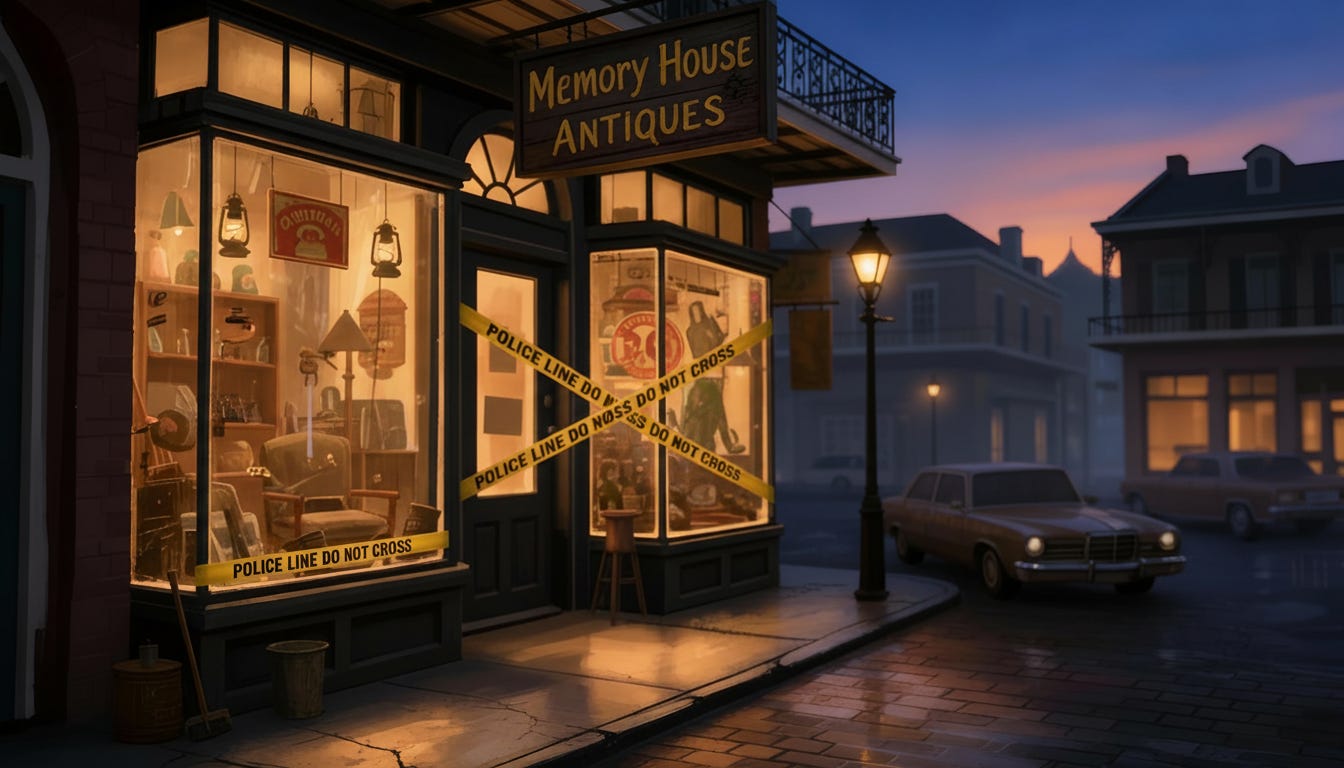
This is a long episode, and it will be shortened by some email servers. If you aren’t reading in the Substack app, please open this in your browser to see the whole episode.
Previously on The Case of the Grinning Golly:
Dolly Mercier, an antique dealer selling controversial items, was murdered with one of her own wares. When a mysterious caller confessed to Jackson Harlow—claiming to be an activist “ally”—the journalist knew he had the real killer on the line. But proving it would mean wading through misdirection, false suspects, and a killer who seemed determined to make Jackson complicit in the narrative.
Harlow Residence
Monday, 7:00 AM
My phone buzzed me awake at seven o’ clock in the morning. I considered throwing it out of the window as I’d only just fallen asleep at 5:30 a.m.
“You called,” Detective Fontenot said.
“I did. I think the killer called me last night.”
Fontenot paused, chewing on my bombshell, no doubt. I rolled over into a sitting position on my bed.
“Okay, I’ll bite. Let’s hear it.”
“A little after nine o’ clock, I got a call. He said he killed Dolly and claimed he was an ally.”
“He? It was a man?”
“Well, actually, I don’t know, they used a voice modulator so I didn’t know their sex. But they knew about the crime scene — about the statue that was used to kill Dolly.”
“What else?”
“He also knew about the blood pattern— “
Fontenot interjected. “We released photos of the statue yesterday afternoon. It’s been all over social media.”
How had I missed that during my evening doomscrolling session? But I still wasn’t backing down.
“He said he left it next to her head as a message,” I offered.
“I hear you, but it doesn’t take a genius to guess that. We have already received seven fake calls saying the same thing.”
“Leo, I’m telling, you, this is real. The way he talked about it. The way he reacted to me. It has to be him. Her. It. Whatever.”
I was done playing the pronoun game. I decided to refer to him as a “he” and hope nobody called me a sexist.
“Jackson, like I told you. We’re getting flooded with false confessions and tips. We had one guy call from Monroe claiming he killed Dolly in a dream using psychic powers.”
I rubbed my temples and stood up. I needed some coffee. Or whiskey.
Fontenot kept going. “Some old lady in Baton Rouge tried to tell us it was all a hoax and that Dolly was still alive. Said she saw her at the liquor store buying a lottery ticket.”
“Listen Leo, I know you’re skeptical, but I’m telling you —”
“Look Jackson, I need to go. I’ve got a murder to solve.”
“Can I at least send you the recording?”
Fontenot sighed. “Yes, send me the recording. Let me know if you find something I can use.”
He hung up. I sent the recording, knowing he was about as likely to listen to it as a chicken is to play with a fox.
My fingers clenched into a tight fist. Not because Fontenot didn’t believe me, but because he was right. I had no proof.
Maybe it was a troll. There are a lot of those going around these days.
I resolved that if this Vader character called again, I would try to trip him up.
I showered, shaved, made coffee, and felt like a new man. Well, I felt like a caffeinated man, at least. I still had a story to investigate.
One of the great things about my job is that I can work from home if I wanted to.
I wanted to, so I did.
The caller said Dolly was working with the Aryan Patriots. I knew it was a longshot, so I decided to look into it. I went to social media to see if others were talking about it.
They were.
But the first post I could find on this alleged connection had been posted at around six o’ clock this morning — after I spoke with the killer. It didn’t mean much. He could have gotten the information on his own. He could have fabricated it.
After wading through a sea of incoherent conspiracy theories, I managed to get a clearer picture.
There were leaked emails between Dolly and Ryan Daltrey, the leader of the Aryan Patriots. Users had posted the screenshots on every major social media outlet.
They seemed real. But I wasn’t sure. I would need some help. I knew just the guy.
I called Charlie Liu.
“Yo Jackson, where you at?” he answered.
“I’m working from home today.”
“Must be nice.”
“It is. I need a favor.”
“I’m a little busy upgrading our cybersecurity system, bro. Can it wait?”
“Depends.”
“On what?”
“On how much you’d like some Cafe Du Monde.”
He loved those damned crack-filled pastries almost as much as I did.
“Dude, don’t do this to me. You know I have an addiction.”
“Consider me your pusher man.”
“Remember that scene in Game of Thrones when they sliced off Ned Stark’s head?”
“Yeah, why?”
“That’s what Mavis is gonna do to me if I don’t have this done by close of business.”
“At least you will lose weight with that humongous brain of yours.”
Liu groaned. It was a bad joke. But I’d only had an hour of sleep.
I said, “I need you to look into the rumors that Dolly Mercier was connected to the Aryan Patriots. It’s all over the internet.”
“Yeah, I saw that. I’ll take a look tonight when I’m off, but I can’t promise any results.”
“Just give it a shot, and those beignets are yours.”
“Okay. I’ll talk to you later.”
I needed another lead to chase down. I leaned back in my office chair. On the day I interviewed Dolly, I spoke with several protesters. I remembered a wiry, high-strung young man named Kyle Weston.
He was outside of Memory House holding a sign that read, “Racism Is Violence.”
I had approached him first. He was wearing blue jeans and a black t-shirt which read “Fuck Racism.” He had dirty blonde hair and the kind of eyes that made him look like a meerkat. At only 23 years old, he was on the front lines fighting for his idea of social justice.
He was also one of Pierce Lemaine’s interns and was often seen with him. He seemed to look up to the politician as a mentor figure.
I introduced myself and asked for his comment on the golliwog issue. “What Ms. Mercier is doing is toxic,” he had told me. “She says it’s about history. But not all history is equal. It’s like she’s rubbing everything in our faces. Imagine how black people must feel knowing someone is trying to make a few bucks off of racism.”
Weston had established himself as a key leader in New Orleans’ left-wing activist class. His connection to Lemaine helped to bolster his reputation as an activist. He might point me in the right direction. I sent him a direct message on Twitter, asking if we could meet up later in the day.
There was also a young lady named Sadie Broussard. She was a student at Tulane University and also a prominent figure in progressive circles. Unlike Weston, Broussard was known to run with the more radical, even violent, elements. The type who dress in black clothes and masks to fight those who they believed were fascists — which was pretty much anyone to the right of Josef Stalin.
If the killer was motivated by politics, Broussard’s clique was probably the best place to gather information. I went to her Twitter account to reach out, but then stopped.
The radicals weren’t exactly fans of the press, so I’d have to take a more sensitive approach with Sadie. And by “sensitive,” I mean ambushing her in person so she couldn’t easily brush me off.
In fact, I was feeling a bit saucy, so I hopped into my Jeep and headed to Tulane University. It was ten thirty, so my target would likely be in class.
I was about halfway through Boz Scaggs’ “Lowdown” when my phone rang.
“This better be good. You interrupted Boz Scaggs,” I said.
“That dirty dirty dirty lowdown?” Mavis asked.
“Yep.”
I smiled. One thing I like about Mavis was her taste in music.
“You didn’t come into the office today. Everything okay?”
“Yes. I’m working on the Mercier story.”
“Are you sure? I figured you’d still be rattled after Saturday.”
“I’m dealing with it. I had coffee.”
“I also thought you might have lost your mind because Charlie told me you’re trying to have him track down some information when he’s supposed to be working on our security system.”
“He said he’d start that tonight, after hours.”
“What do you think is happening with the Aryan Patriot angle?”
“I don’t know yet. I’m shaking the trees — seeing what falls out. Also, the killer called me last night.”
“Why am I just now hearing about this?”
“Fontenot thinks it’s bullshit. Apparently, every nutjob in Louisiana is calling NOPD with fake confessions.”
“What proof do you have that it was the killer?”
“He told me. But, as Leo so delicately put it, this doesn’t prove anything.”
“What did he say?”
“He said he killed Dolly because she was selling those racist artifacts.”
“That’s what I’d say if I wanted to troll a gullible journalist.”
I smiled. That woman knew how to stick the dagger and twist it.
“I know I know. I thought it was a troll at first. But there was just something about it that I can’t put my finger on.”
“Well, let me know if there’s anything new. Where are you headed now?”
“I’ve got a hot date with a radical named Sadie Broussard.”
“How nice.”
“Nothing like a white progressive lecturing me on white privilege and blah blah blah.”
“Well, let me know if anything comes of it.”
“Will do.”
Tulane University
Monday, 11:00 a.m.
I pulled into the parking lot. I checked my direct messages and saw that Kyle Weston had responded. We would meet at the Lagniappe Coffee Shop across from Memory House.
When I interviewed Sadie at the protest, she told me she worked at the Howard-Tilton Memorial Library, the main place where students went to expand their eager, fertile young minds.
I didn’t quite feel right about ambushing Sadie like this. But I’ve been around activist circles enough to know that if there is anyone radicals want to avoid, other than the police, it’s nosy journalists like yours truly.
It was already hard enough to get a comment from her at the protest. Now, there has been a murder — one that appeared to be politically motivated. There is no way she would have agreed to speak with me.
I walked into the building. I looked for a tall girl with pale skin, glasses, freckles, and fire-red hair. She wouldn’t be hard to miss.
The building sprawled out like a palace, decked out with bookshelves that seemed to go on into eternity on each side. Fortunately, it didn’t have that old, musty smell some libraries have. Instead, it was a sanitized, modern scent of paper and boredom.
I was glad to find out I was wrong. After about 15 minutes, I spotted my prey in an aisle near the back of the room. She was standing next to a cart full of books, putting them back in their homes on the bookshelves.
“Hello Ms. Broussard,” I said.
She turned to look at me. Her face grew almost as red as her hair. Her eyes narrowed. They were puffy and red, like she had been crying. There was a small bandage on her forehead which made me wonder if she had been hit by a falling book.
“What are you doing here?” she half whispered half grunted.
“I need to ask you some questions.”
She placed another book neatly on the bookshelf.
“I’m working.”
“So am I.”
“Even if I weren’t working, the last person I’d want to talk to is you.”
I acted as if I were hurt.
“Why, whatever do you mean?”
“You want to talk about that murder, don’t you?” she said.
“I just want to ask you a few questions. I won’t take up too much of your time, scout’s honor.” I raised my right hand as if swearing an oath.
She snorted. “I bet. You probably think it was one of us who killed that woman.”
“I’ve seen no evidence suggesting it — yet. I’m only certain of two things: There was a murder and the people have a right to be informed about it.”
“Bullshit. We get blamed for everything.”
“And sometimes it’s deserved. But if the person who did this doesn’t represent you, shouldn’t people know that?”
She stood up taller and looked right at me. I thought it was cute.
“I don’t want to talk to you.”
“You already are.”
“Then maybe you should leave.”
“Maybe I should stay, and let your comrades see you speaking with a journalist. I wonder what they would think of that?”
“Fuck you.”
“Look, I don’t want to play hardball. But I’m going to get to the bottom of this one way or another,” I said. It was time for this game to end.
“I’d rather give you and your friends an opportunity to tell your side of things. I only need about 30 minutes of your time, then I’m out of your hair.”
“15 minutes.”
“Deal.”
“Meet me at the football field in an hour.”
“Sounds like a plan.”
I took a stroll to the football field and sat on the bleachers. I thought about how I would approach the conversation with Sadie. She did not want to talk to me — and I couldn’t blame her.
The afternoon sun beat down on the empty bleachers. Somewhere across campus, I heard someone blasting loud hip-hop music. I couldn’t tell who it was because today’s artists all sound the same to me.
I longed for the days of Biggie and 2Pac.
As far as I knew, Sadie hadn’t participated in her clique’s more violent escapades. But this didn’t mean one of her friends hadn’t decided Dolly needed killing.
I was operating under the assumption that politics was the driving force behind whoever killed Dolly. But there were plenty of people who were furious at her over the golliwog issue. It could be just about anyone.
I had to play this right — make sure I wasn’t coming off as accusatory. Otherwise, I might lose her.
I scrolled through her Twitter page. It was the usual boilerplate leftist claptrap. Selfies with friends at protests. Rants about the police.
“Pigs are just fine with protests, as long as we don’t make the government too uncomfortable,” one post read, showing a video she had recorded of police in riot gear hurling tear gas at a throng of protesters.
Well, I couldn’t say she was wrong. I’ve been at this long enough to have seen this on many occasions.
She had also written a post about the murder. “Prediction: The fascists are going to blame us for this,” she wrote. “In fact, they have already started. Guilty until proven innocent.”
That was probably true too. I could use this.
Sadie approached from the other side of the field. She trudged through the field deliberately, as if she had mentally prepared for the interrogation she was sure I was going to give her.
I smiled. “Well hello there. Long time no see.”
Sadie looked at me like I was a roach she had just scraped off her shoe. She wore a black tank top and blue jeans, the type that already come with holes torn in them, for some reason.
She sat down next to me, her arms crossed. Not too close, but far enough away that we could hear each other talk.
“I’m here. What do you want?”
She steeled herself for the first question.
“For what it’s worth, I think you’re right.”
“About what?”
“They do think you’re guilty until proven innocent. And the police are there to crack down on protests that make those in power uncomfortable.”
“Either you’re a mindreader, or you’ve been going through my social media.”
“I was bored.”
“You’re probably just saying that to get on my good side.”
“You’re probably just saying that because you haven’t read my work. If you had, you would know I’m no fan of the government.”
“You’re not about to tell me you’re one of us, are you?”
I laughed. “Hell no. No offense, but if your people ever gained power, I’d oppose them as much as I do the current status quo.”
She paused. I had thrown her off a bit. It’s what I do.
“So you’re a Republican?”
“Don’t make me laugh.”
“Then what the fuck are you?”
“I’m a journalist. I report on the news. I report on bad people. I make sure the public knows what their so-called leaders are up to.”
“Bullshit. The media are just propaganda for the elites.”
“Yes. Most of it is. But I’m not. You don’t have to take my word for it. My work is available for all to see.”
“So, why are we here?”
“I want to know who killed Dolly.”
Sadie snorted again. She liked snorting.
“It wasn’t one of us,” she said.
“You were there are the protest, right? Did you see anything suspicious?”
She sighed. “I was a bit preoccupied.”
“Did you know Dolly?”
“No,” she said, a little too quickly.
“You sure?”
Sadie brushed some hair out of her face and looked out at the football field.
“I don’t hang out with racists. I don’t talk to them. My only interaction with Dolly Mercier was yelling at her about her racist bullshit she was selling.”
Her face was red again.
“I didn’t kill her,” she said.
“I never said you did.”
“I didn’t want her dead. I wanted her to stop glorifying oppression.”
“You thought yelling at her would change her mind?”
She looked away from me, across the field, as if expecting someone to come along and rescue her.
“I don’t even know what I think anymore,” she said. Her voice was quiet, resigned. There was something she wasn’t telling me.
“Sadie, I know this isn’t easy. You want to make the world a better place. I respect that. But if you don’t mind me saying, you don’t really seem like the violent type, despite who you hang out with.”
“Are you calling me a poser?”
“I think you’re trying to do what’s right. Dolly’s death wasn’t right. I just want to know what happened. Do you have any information that could point me in the right direction?”
“Look, sometimes people aren’t who you think they—” (stops herself) “Never mind. I need to go.”
“Sadie —”
“No. I need to go. Please don’t contact me again.”
She stood up abruptly and walked quickly back across the field.
Well, that didn’t go too smoothly. Great job Jackson.
Sadie was definitely not being forthright with me. That much was about as obvious as a tiger in the gazelle exhibit at the zoo.
But guilty of murder? I wasn’t sure. She was definitely conflicted about something — but what?
I thought I might have better luck with Kyle Weston. It was about time for our appointment.
Lagniappe Coffee Shop
Monday, 1:30 p.m.
I drove back to the coffee shop. I’d spent a lot of time there over the past 24 hours. Good thing for me, I had grabbed one of those loyalty cards where they give you a stamp every time you buy a drink. Once I got to ten coffees, I’d get a free cup.
I love capitalism.
Kyle was already there, sitting at a table in the corner. He was wearing a blue t-shirt that read “Resist” and shorts because he was 23 years old and hadn’t figured out he was a walking cliche.
He stood as I walked to the table and shook my hand with a smile. “Nice to see you again Mr. Harlow.”
“You can call me Jackson. You want a coffee?”
“Nah, I’m good.”
“You sure? I only have to buy eight more before I get a free one. You’ll be doing me a favor.”
I flashed my loyalty card like a wealthy douchebag showing off his new American Express Black Card.
“In that case, I’ll take a latte.”
“Good man.”
I approached the counter and was greeted by a very nice young woman with a nosering and spiky hair. Her name was “Cynthia,” if her name tag was to be believed. I always suspected that these people chose fake names to pull one over on the customers. It’s one of my favorite conspiracy theories.
I sat down across from Kyle.
“Thanks for meeting with me,” I said. “I’m covering the Mercier murder and I want to make sure my readers understand what’s been going on.”
“No problem. I’m meeting Pierce here in about an hour. Is that an issue?”
“Not at all,” I lied. I had already avoided politician cooties and now I was about to be exposed to them again. “I’m sure you already heard the news about Dolly, right?”
“I won’t pretend I liked her. But this was not the way to handle it.” He paused. “She was still a human being.”
Kyle’s eyes turned downward. He fiddled with his napkin and tapped his foot like a woodpecker going at an oak. I didn’t think he needed any coffee.
“I understand you’re well-known in activist circles.”
“Yeah, I’ve been involved in politics for a few years now.”
“You’re also an intern for councilman Lemaine, correct?”
“Yes, I’ve been with Pierce for over a year.”
“What do you think of him?”
“I think he’s the future of politics. The type of leader we need. I’m grateful to be working with him. He’s been a great mentor for me.”
Kyle looked like he wanted to keep singing Lemaine’s praises, but was interrupted by “Cynthia.”
“Denzel!” I heard spiky-haired nosering chick yell. I got up to retrieve our coffees. Yes, I also gave a fake name. Two can play that game.
“Denzel?” Kyle asked when I got back to the table.
“It’s a thing I do,” I explained.
“Fair enough. So how can I help?”
“Did you know Dolly Mercier?”
“I didn’t know her personally. But I was part of most of the protests in front of Memory House.”
“So, it’s safe to say you didn’t approve of her merchandise.”
Kyle snickered. “Not in the slightest. You know the history of this country. People who looked like me put people who looked like you in chains. Mocked you. Oppressed you. Stifled your voices. Took your freedom.”
“That they did. But I doubt my ancestors would look at me today and say I’m suffering like they did.”
“Yeah, but you have to admit there are still problems today. The fact that a white woman can sell Jim Crow-era relics without pushback shows that we haven’t come as far as people think.” Kyle sounded almost rehearsed, as if he were Edward Norton delivering lines from the script.
“You haven’t even touched your coffee yet. Cynthia is going to think you don’t like it,” I pointed at his cup.
“Cynthia?”
“The girl at the counter.”
“Oh, right.” He took a sip.
“Not bad,” he said. “Anyway, I think those items are racist caricatures from another era — one that should stay dead. But these people just can’t let go of the past, you know what I mean?”
“I do. Tell me about the protests.”
I liked Kyle, but I’d had to sit through this type of whitesplaining far too many times to do it again. I can rag on conservatives all I want — but at least they rarely lectured like this.
Kyle took another sip. He seemed to be enjoying it. I looked over and gave “Cynthia” a thumbs up.
“Our group organized peaceful protests outside her shop.”
“It wasn’t so peaceful last week.” I took a sip.
“We stayed on public property. Followed all the ordinances. But those rednecks think they own everyone.”
“And by ‘rednecks,’ you’re referring to the people who supported Dolly, right?”
“Precisely. They were there too, just looking for a reason to hurt us. Racist assholes. The cops clearly sided with them when things got violent,” Kyle’s fists clenched.
This wasn’t exactly true. I read the reports, watched the camera footage on social media. It wasn’t clear who started the violence. But the police cracked down on everyone. Arrested multiple people on both sides.
I didn’t think it would be productive to raise this issue with Kyle, so I pressed on.
“These items, golliwogs, why have they become such an issue? People have been selling them for decades.”
Kyle thought for a moment. He took another sip of his coffee.
“It’s because people’s minds are changing. More people are waking up, man. We’re not going to tolerate this shit anymore.”
He became more animated. “Look, Dolly had the RIGHT to sell these objects. But we also had the right to speak up, and that’s what we did.”
“Do you think anyone in the activist community might have wanted to take it further?”
“You think an activist did it?”
“I’m not sure. I’m just trying to piece this all together.”
“I doubt it. We despise violence. We hated what Dolly was doing, but we didn’t want to hurt her — well, most of us didn’t. I can only speak for myself and those in my circle.”
I finished my coffee and considered ordering another.
“Most of us? What can you tell me?”
Kyle sat back in his chair. He looked as if he had accidentally spoiled my surprise birthday party.
“Mr. Harlow, I don’t want to accuse anyone who might be innocent. You probably already know there are some in the activist community who prefer direct action. I know a lot of these people — but I don’t agree with them.”
“Are you talking about Sadie Broussard?”
He nodded. “I’m not saying it was her or someone in her group. But I’ll say this, if it ends up being one of them, I will be less than shocked.”
“Okay.”
“I mean, Sadie and others were talking about doing more than protesting. I heard them at the protest and tried to reason with them.”
“What happened?”
“Nothing happened. But it just felt like she was getting way too extreme. I’ve known her for awhile now. But she’s not the only one, she’s just the one who stands out to me. She mentioned that they needed to shut Memory House down by ANY means necessary.”
“Ah, the honorable El-Hajj Malik El-Shabazz.”
“Huh?”
“Malcolm X. That’s what he changed his name to later in life. He’s the one who said, ‘by any means necessary.’”
Kyle scratched his head. I could tell he was used to being the most knowledgeable person in the room.
“Can I ask YOU something, Mr. Harlow?”
I nodded.
“What do you think of this whole thing? Not just the murder, but the golliwog thing?”
“I think the outrage is silly, to be honest.”
“What? You? You’re a black man. If anything, this should affect people like you the most.”
“It doesn’t.”
“Why?”
“Someone selling racist memorabilia isn’t affecting my bank account. It’s not keeping me from living my life. It’s history. It’s ugly history, but pretending it doesn’t exist isn’t going to help anyone.”
Kyle’s eyes widened. He looked at me as if I had transformed into a newt.
“You sound just like her. Don’t you realize how much this hurts your community?”
“The government has done far more to hurt my community than a mammy doll, Kyle.”
His face fell. His mouth opened and closed, as if he wasn’t sure how to respond.
The door opened and in walked Councilman Pierce Lemaine. He stood at the entrance for a moment, looking around for Kyle. When he saw us sitting together, he beamed as if it were the best surprise he’s had all day. He stepped over to our table.
It would probably take me three month’s salary to afford half of his suit. His handshake was firm, like he meant it. “Mr. Harlow, I didn’t expect to see you here.”
“I tend to show up in places where I’m not expected,” I said.
Lemaine laughed and put his hand on Kyle’s shoulder. “This guy isn’t preaching you to death is he?”
Kyle chuckled, “No Mr. Lemaine. We’re just having a civil political discussion.”
“I bet,” Lemaine said. “Y’all want refills on your coffee?”
We didn’t. He went to the counter to place his order. “Cynthia” seemed quite smitten with the councilman.
I decided to get the conversation back on track.
“If you were me, where would you be looking?”
“Honestly, Sadie’s group is worth looking into. But have you considered it might not even be political?”
“What do you mean?”
“There’s another antique dealer. Name’s Colin Reddick. He owns a place down on Royal street. I heard there was some bad blood between him and Mercier.”
“What kind of bad blood?”
“I don’t know man. I just hear things, y’know?”
Lemaine returned to the table and sat down. Whatever he ordered smelled like heaven.
“What did you order? That smells delicious.” I had to ask.
“Peppermint mocha with a hint of vanilla. It’ll change your life,” Lemaine said.
Well, at least he had decent taste in coffee.
“Have you learned anything new about the murder?” Lemaine asked.
“Not yet. My investigation is still in the preliminary stages. That’s actually why I’m speaking with Kyle. Thought I’d pick his brain a bit,” I said.
“Good idea. Nobody is as plugged in as Kyle. He’s the best person to point you in the right direction,” Lemaine said.
Kyle sat up a little straighter, as if his coach had just praised him for scoring the tiebreaking touchdown just before the buzzer went off.
“I learned from the best,” Kyle said.
“Well, I’m going to head out. Gotta follow up on the information you gave me. I appreciate your time, Kyle,”
“No problem. Look, like I said, Dolly didn’t deserve to die. But honestly? She was stubborn. Refused to listen to reason. She could have easily calmed things down. But some people would rather profit from racism.”
“I know we didn’t agree with her, Kyle. But now’s not the time to speak ill of the dead. You know what I mean?” Lemaine chided, gently.
“Yeah, I know. Things will get better when you’re mayor,” Kyle said.
“We still got a tough campaign. We’ll see how it shakes out,” Lemaine said.
“Well, good luck. I’ll be in touch,” I said.
I stood up, saluted “Cynthia,” and walked out of the shop.
I replayed the conversation in my head. Kyle Weston was exactly the kind of activist his movement needed—smart, articulate, willing to condemn violence. He was not like Sadie, who’d been defensive and evasive. He had given me real leads, real context. I made a mental note to quote him in my article.
My position on the golliwogs threw him. But that was his youth showing—like most progressives, he expected every Black person to think alike. But I was confident he would learn some nuance at some point.
It was interesting seeing Lemaine in a more casual setting. If he weren’t a politician, he might have grown on me.
Harlow’s Home
Monday, 6 p.m.
I arrived home a little after six o’ clock in the evening. It was time to get to work on my next report on the Mercier case. But first, I wanted to check in on Estelle. She’d had a rough day yesterday.
“Hello?” She answered.
“Estelle, it’s Jackson Harlow. I wanted to check on you to see how you’re holding up.”
“I…I’m okay,” she stammered. Her voice sounded like a flute stuffed with gravel. Probably worn out from crying and talking all day to police.
“I keep expecting her to call about some estate sale she found or to gripe about a customer.”
“I can’t even imagine what you’re going through. I didn’t know Dolly well, but I could tell she was a good person.”
“She was, Mr. Harlow —”
“Call me Jackson.”
“-- Jackson. She was wonderful. She helped me out so many times. She was about as tough.”
“I could tell.”
“I just don’t understand how anyone could do this. What the hell is happening to our city — and our country?”
She began sobbing. I let her.
I didn’t have an answer to her question, so I didn’t give one. It felt like a vise grip was tightening on my heart. I hated this. So much pain over some dolls.
The sobbing slowed down, then faded. She spoke again.
“I know you’re looking into it Jackson. But the police don’t even have a suspect. Have you found anything?”
“Not yet. I’m still looking at a few angles. I know you’re not up to it right now, Estelle. But when you’re ready—maybe in a few days—I’d like to speak with you. Not just for my reporting, but to truly understand who Dolly was and who might have wanted to harm her.”
“That would be fine.”
“I’ll call you in a few days to check in again. But if you need anything, you have my number now.”
“Thank you.”
She hung up.
I wanted to go to bed — even though it was early. But I had work to do.
I wrote about what I had learned about the case so far. The murder weapon. My interview with Pierce Lemaine. I added quotes from Kyle Weston and Sadie Broussard.
Sadie Broussard. Weston intimated that she might have been willing to resort to violence. But it was hard to believe. Sure, she was passionate. But nothing about her screamed “Hey Harlow, I’m totally a killer.”
I opened up a new draft in The Bayou Chronicle’s Content Management System, otherwise known as CMS. I wrote up my notes about my interviews and laid out my thoughts on the case. I included parts of my conversations that did not make it into the latest article. This helps me see all the angles to a particular story.
I sat down on my couch for my nightly doomscrolling ritual. The moment I opened the Twitter app, a call came through. Unknown number.
Could it be?
I answered.
“This is Harlow.”
“Hello Mr. Harlow. Sounds like you’ve been working late,” the modulated voice taunted.
“You again. I was hoping for a telemarketer. You sure you don’t want to sell me a timeshare or something?”
He ignored my joke. I couldn’t blame him. It was getting a little corny at this point.
“You have had quite a busy day. Did you think about our conversation from last night?”
“Sure. But here’s the thing: I’m not convinced you’re the killer. I think you’re some incel in his mother’s basement trying to troll the media.”
I didn’t really think he was a troll. But I wanted to see where this would go.
“I told you about how I killed Dolly, didn’t I?”
“Yes. But you’re one of thousands of people who already knew about the murder weapon. I remain unimpressed.”
He paused. He was probably trying to conjure a detail that had not been publicized yet.
“You know the first thing I noticed when I saw the woman? Those tacky earrings.”
My pulse quickened. I knew what he was talking about.
“Okay, I’ll bite. What did they look like?”
“Those godawful things. Shaped like seashells. I should have killed her for that alone.”
He was right. That’s exactly what she was wearing. I still had to play it cool.
“Let’s say I believe you. Why are you calling me?”
“Because I know you will listen. Most reporters—they just want a villain, or a headline. Not you. You write about the big picture, not just the sexy details. You tend to dig where people usually walk away. You’re honest. I think you’re the perfect one to tell my story.”
“You flatter me, sir. But I’m not giving you my autograph.”
The voice chuckled. He seemed to get a kick out of it. I was glad one of us was having fun.
“You ever wonder what pushes someone to the edge, Mr. Harlow?”
“I’m sure you’re about to tell me.”
“It’s doing the right thing, over and over and over again and not getting the right results.”
“Definition of insanity?”
“Sort of. We tried dialogue. We tried pressure. All people want to do is talk. They’re all talkers. But I’m the only one who had the balls to take action. I’m a doer.”
“And now a woman is dead.”
“Yes, she’s dead, Harlow! She could have avoided it. But she chose to keep profiting from division. You know the damage she was doing and you know I’m right.”
“I get it. We live in a wicked society under a wicked government full of wicked people.”
“See, you DO understand.”
“But, murderers are the most wicked of all. You killed a woman for selling dolls. The city was already a powder keg — and I think you may have just lit the flame.”
“Sometimes, you have to become what you hate to eradicate what you hate.”
I didn’t answer. A few seconds passed.
“Are you listening, Mr. Harlow?”
“Yes. I’m just waiting for the part where you say ‘We’re not so different, you and I.’” I tried my best to emulate James Earl Jones’ iconic baritone.
“You still think this a game. I should visit you next.”
He was shouting now. I had struck a nerve. I pressed the advantage.
“Because we’re nothing alike,” I continued, ignoring the threat. “You sound like a wannabe white savior with a God complex who thinks he was put on this Earth to rescue poor, helpless negroes like me.”
“FUCK YOU HARLOW!”
“You know I’m right, white boy.”
“I don’t have to be black to care about oppression! I’m doing more to help people like you than you ever will.”
“You’re a coward who thinks he’s a real man because he bludgeoned an old lady to death over some dolls.”
“No!” he screamed. “You don’t know shit.”
“What I do know is that when I catch your pansy ass, you’re going to wish the police had gotten to you first.”
He paused. Collected himself.
“I guess we will see, Mr. Harlow.”
The line went dead.
I felt much better about this call. And, I found out the killer was white. It wasn’t much, but it was something. I also learned how to push his buttons. That might be useful later.
But even though the call was a win, I knew the caller was dangerous. I wasn’t sure if he would kill again and I knew I had to catch him before he could.
Despite his threat, I doubted he would come after me. I was his sounding board. He wanted me to listen and tell his story. But I wasn’t going to take this for granted. I’d certainly riled him up, and this could make him irrational.
I made sure my pistol was on the nightstand, plopped down on my mattress, and drifted off to sleep.
Harlow’s home
Tuesday, 6 a.m.
I woke up at six o’ clock in the morning. I felt much better than I had the previous morning. I headed to the garage to get in a quick workout. Lifting gave me the jolt I needed to carry me through the rest of the day. Well, that, and coffee.
On my way to the office, I grabbed a dozen beignets for Charlie and a cup of steaming hot java. Today was going to be a good day.
After parking, I strolled into the office. I immediately felt that something was wrong. It was as if an invisible cloud had descended on a usually bustling office. I could hear the keystrokes of my colleagues tapping away at their computers.
The sounds faded out. I saw some of my coworkers sneaking glances at me.
I walked over to Charlie’s desk.
“Yo, Charlie! I got something for you.”
Charlie looked up and forced a smile.
“Thanks, man.”
“Change of plans. I’m not giving these to you until you tell me what’s wrong.”
His face dropped the smile and replaced it with a look of concern. His brow was furrowed and eyes downcast.
“You might want to check with Mavis.”
I handed him the box and made a beeline for the boss’ office.
“Why does this place feel like cemetery all of a sudden?” I asked.
Mavis looked up from her computer screen.
“Jackson. Have you looked at social media lately?”
“Not since last night, why?”
“You might want to check.”
I looked at my notifications. I had more than 200 notifications..
And then I saw it. A line of posts with screenshots of the notes I had put in CMS last night. Everything that was never meant for public consumption was all over Twitter — and likely on other social media platforms. Even worse, people were attacking me and The Bayou Chronicle.
It was all there. My impressions of Sadie and Kyle. I had written about Sadie’s radical views and her comments about Dolly. Her ties to radical groups. No wonder she was the focus of the online outrage — she was the perfect target.
I’m used to being attacked on social media by everyone from all sides because I won’t join one.
But this was different.
In the trending section, I saw a headline: “New Orleans Journalist Targets Activist Community in Mercier Killing.”
What. The. Actual. Fuck.
“It was only a matter of time before the media started exploiting this woman’s death to attack us,” a user named “AntiFascist2020” wrote.
“Screw this guy. He’s a feckless hack using this woman’s murder to make a name for himself. Objectivity, my ass,” another user said.
Well, that was to be expected from the left. But the right wasn’t exactly grateful either.
PatriotMom1776 wrote, “So-called ‘journalists’ like this Harlow character are just carrying water for the left. The fact that he only mentioned these terrorists in his private notes shows that he’s part of the coverup.”
Et tu, conservatives?
“All of these DEI reporters are destroying our country. #JacksonHarlowHatesWhitePeople,” another user wrote.
Since my day didn’t start out badly enough, CNN posted a video reporting on the fiasco.
“New Orleans journalist Jackson Harlow, with The Bayou Chronicle, is facing a barrage of criticism for allegedly blaming the activist community for the murder of Dolores ‘Dolly’ Mercier, a local antique shop owner,” the blond haired talking head said. “This comes after his notes about local activist Sadie Broussard and her fellow activists were leaked online.”
Fuck.
The reporter went on to discuss Sadie’s ties to radical antifascist movements. On the screen was a post she had written. “Some stains never wash out,” she had posted on Saturday.
A ball of rage expanded in my chest like a balloon slowly inflating. No matter how many times I saw people lie on social media, it still irked me. But when it’s directed at me, it’s even worse. These animals would do anything for clicks and ratings.
I didn’t even want to think about what Sadie was facing online. Yes, I did low-key suspect her, but I never actually wrote that in my notes. But the truth doesn’t matter to social media.
“Mavis, I —”
“Stop right there, Jackson. If you’re about to tell me you didn’t leak this, don’t bother. I already know you didn’t.”
“But —”
“Either we have a leaker, or someone hacked us. My phones been blowing up all morning.”
“So what do we do now?”
“Well, you are going to keep investigating. Charlie and I are going to get to the bottom of this. He’s already got his team working on it.”
“Are you sure I should keep working on this case?”
“Would it matter if I told you not to?”
“Well…”
“Yeah, that’s what I thought. Don’t worry about the bullshit, Jackson. Just do your job. We’ll handle the rest. And be careful out there. Now you have a target on your back.”
“What else is new?”
“I mean it, Harlow. Keep your head on a swivel. You know how tense things are right now.”
“I’ll be fine. I won’t be alone. My friends Smith and Wesson are always with me.”
I patted my hip where I carry my pistol — concealed of course. With one in the chamber.
“Please don’t shoot anyone, Jackson,” Mavis sighed. She was putting up a good front. But the worry had etched itself onto her eyes.
I walked out of her office and headed for my desk. I sat down at my computer, but I couldn’t figure out what to do next.
“I’m sorry, man.” Jason Whitaker stood behind me.
He was one of my fellow reporters — covered white collar crime.
“Thanks,” I said.
“It’s wild. I also write my notes in CMS. I never would have thought they would make their way into the interwebs.”
“Me neither. But the world is full of surprises, isn’t it?”
Jason nodded, “Hell yeah. Hang in there bud.”
He walked away.
That’s what I said out loud. Inside, my mind was spinning. Who would have done this? Were they trying to throw off the investigation? Did they have a personal vendetta against me?
I’d certainly made my share of enemies. Corrupt politicians. Corrupt police. Corrupt businessmen. If it was corrupt, it hated me — and the feeling was mutual.
I had another lead to explore. I wanted to speak with Estelle, but I knew she wouldn’t be ready yet. I wanted to look at Colin Reddick. But first, I had some calls to make.
My phone buzzed. It was a text message. It was from Sadie.
“We need to talk,” the message read.
“Give me 15 minutes,” I wrote back.
I called Fontenot.
“How does it feel to be famous, Harlow?” Fontenot answered — a bit too smugly, I might add.
“Feels great. Fox News has already reached out to give me my own show.”
“Well, I’m glad you’re taking it in stride. Tough break, man.”
“Have you found any new information?”
“Not much. We heard from someone who says he saw a woman leave Memory House on the evening of the murder. And a college kid who looked like he was walking off seven shots of tequila.”
“Hmmmm,” I said.
“Yeah, it’s not much to go on. But we’re looking into it.”
“Okay.”
“Off the record, we’re looking into a suspect. Can’t tell you who yet. But once we have more information, you’ll get the scoop.”
“You sure you can’t just give me hint?”
“No.”
“You’re no fun.”
“I try. I’ll talk to you later, Harlow.”
Harlow’s Jeep
Tuesday, 10:00 a.m.
I went to my car. I wanted to call Sadie away from prying ears.
She answered on the first ring.
“What the fuck, Harlow???”
“Sadie let me explain —”
“I should never have spoken to you! I can’t believe you set me up!”
“Listen, I didn’t set you up, Sadie.”
“Don’t lie to me Harlow!” She was shrieking. I could hear the tears in her voice.
“How could you do this to me?”
“Sadie, look. I didn’t set you up. Those notes were never meant to be public.”
“Then why the hell am I seeing them all over social media? I’m getting death threats, Jackson. Don’t bullshit me.”
I kept my tone calm. I needed her to listen so a spoke more quietly so that she would have to focus on my words.
“Sadie. Think about it for one second. If I wanted to set you up, everything that was in my notes would have been in the article I published.”
I could hear her breathing. But she didn’t respond.
“I would have had no reason to hide it. I sure as hell wouldn’t have leaked it online,” I said. “Someone else did this.”
“But you obviously think I killed her.”
“I never said that. I didn’t even write that in my notes.”
“Well if you didn’t do it, who did?”
“We’re trying to find out. I’m sorry.”
“Well what the hell am I supposed to do with that?”
I could hear the terror in her voice. My stomach was twisted like a pretzel.
“Stay off social media. Lay low for awhile. We’re going to get this sorted out. I’ll call you later, ok?”
“I hope you didn’t do this Jackson. I thought you were different.”
“I understand. Give me some time.”
She hung up.
I didn’t know what to make of it. She sounded convincing enough. But she was partially right — I still believed there was a chance that she was the killer. But I had some more investigating to do.
Reddick & Company Antique Shop
10:45 a.m.
I drove down to Royal Street. It was time to pay Colin Reddick a visit. After I parked, I took out my phone and started doing some research on him. He was the owner of Reddick & Company Antique Shop.
There were several local news reports about Reddick. Apparently, he was well known in the field of antiques, having dealt in some high-ticket items. One article called him “The King of Antiques.” Nothing seemed out of the ordinary.
I looked at the online reviews. Most were positive. But at least one user claimed they were “sold a fake” and were “still waiting for a refund.”
I continued my research. No public criminal charges. However, his name came up in civil suit paperwork with “disputed consignment proceeds.” The case was settled out of court.
Reddick was also listed as a plaintiff in a few defamation cases.
I decided to see what I could find out. I went into the shop and looked around. It looked similar to Memory House. An array of curiosities greeted me as I took in the place. Old bicycles. Vintage record players. An old school phone where you removed the receiver, put it to your ear, and worked the crank until you reached an operator named Mildred.
Richard Marx was playing on the radio, informing his lover he’d be right there waiting for her.
I walked further to the back where double wooden doors led to another room. A big room. This must have been where Reddick kept the good stuff for rich folks.
It was more of a large hall than a room. It resembled a museum exhibit. To the right was a plantation-era writing desk that looked like it could have belonged to Jefferson Davis. It was made of ornate heavy dark brown mahogany. I barely resisted the urge to sit behind it and say “I do declare” in my best Confederate accent.
To the left sat a brass-bound maritime trunk that looked like it had shivered more than a few timbers in its day. It was advertised as having been saved from an 1850s Gulf Coast shipwreck.
Further down was a sterling silver tea service which gave me a peculiar craving for crumpets and grape jam. The sign said it had been gifted to Reddick and Company by a prominent southern family.
There were footsteps out in the front lobby, coming closer. “Hello there, can I help you” Reddick’s voice said from behind me.
I turned around and looked at him. He was average height. His piercing blue eyes looked me over, trying to discern what caliber of customer I might be. He was balding at the top, but hair crowned the sides of his head and extended into a long brown ponytail.
He appeared to be in his mid 50s. He wore an expression that reminded me of a used car salesman who sold previously owned Lamborghinis.
“Yes, I would like an order of Earl Grey and crumpets. Grape jam, if you please.”
Reddick looked at me as if I had just defecated on his floor.
“I’m not sure what you mean, sir,” he drawled.
“I was just admiring this tea set.” I smiled.
“I see. If you don’t mind me saying, you look familiar.”
“I have one of those faces.”
“Naw. You’re that journalist boy, right?”
I kept my composure, but being called “boy” made me fantasize about slapping the taste out of his mouth. But I didn’t act on that impulse.
“I’ve been known to write an article or two.”
He walked up to the tea set and examined it carefully. After he confirmed that this strange Negro hadn’t swiped one of his silver cups, he turned back to me.
“You’ll have to pardon me sir, not many people from your background shop in this section,” he said.
“Oh, word?” I said. “Well I couldn’t help but admire your wares.”
“Yes, a lot of people do. You won’t find a finer selection of antiques.”
“I wanted to ask you some questions.”
His eyebrows sprung toward the ceiling.
“Let me guess — about Dolly Mercier.”
“You’re a sharp guy, Mr. Reddick.”
He tried to hide it, but the corners of his mouth perked up into a quarter of a smile.
“What’s on your mind?”
“Did you kill her?”
He laughed. I laughed too.
“Quite forward of you.”
“Well, the police haven’t been able to find out so I figured I’d try to make a name for myself by solving the crime. Can’t blame me for trying, can you?”
“I suppose not.”
He smoothed his hair — or what was left of it.
“You’ve been in this business awhile, right? What made you get into this racket?”
“I love history and all of its artifacts.” He turned with a sweeping gesture covering the entire room “Every piece here has a story. My passion for Americana that makes me the best at what I do.”
Time for some prodding.
“Ever have problems with fakes or forgeries?”
He bristled slightly, but didn’t crack. He rubbed his chin.
“I don’t know what you been reading on the internet, but everything I sell is bonafide.”
“Oh, no doubt,” I said. “I saw a lot of chatter online about the plantation desk. Dolly seemed pretty certain it was a copy. You two ever sort that out?”
“Dolly said a lot of things, God rest her soul. It’s a shame what happened to her. Do you know if the police are close to solving it?”
“I have no idea, but I think they’re close,” I lied.
“Good. I hope they catch that bastard.”
His monotone drawl carried less emotion than Eeyore.
“I heard y’all had some bad blood, so to speak.”
“We didn’t always see eye to eye, Mr. Harlow. To be frank, she told a lot of lies about me. Probably because she didn’t like the competition.”
“What kind of lies did she tell?”
“The usual. Claimed my merchandise was fake. She claimed I was falsifying the provenance of my selection.”
“Can you repeat that in English?”
He raised an eyebrow, looked at me as if I had just asked him how to tie my shoes.
“Provenance, sir. It’s the most important part of this business. It refers to the life of an antique — where it has been, who owned it, what it lived through.”
“So this plantation desk, what’s the, uh, provenance behind it?”
“It was owned by a prominent Confederate general and his family. It was one of the few items that was recovered after the northern invaders arrived to set fire to the plantation.”
“I see. Quite a story.”
“Quite.”
“I noticed you have sued a few people for defamation. Was Dolly on the list?”
His facial expression had “bless your heart” written all over it. I really didn’t like this guy.
“Frankly, that’s none of your business.”
“Some have said you have a knack for discovering documentation that adds to a piece’s value just when you need to make a sale. Coincidence?”
“Mr. Harlow —”
“Have any buyers ever tried to take you to court over false provenance claims? Ever had to pay any settlements?”
“Mr. Harlow — “
“What did Dolly do to make you angry?”
I was just fishing now. But I wasn’t catching anything.
“I’m going to have to ask you to leave.”
“Just wanted to give you a chance. It’s better if it comes from you instead of me having to dig it up.”
“You have a good day, Mr. Harlow.”
“I’ll do that.”
I still had a hankering for crumpets.
Estelle Mason’s Residence
11:37 a.m.
I got back to my car after my conversation with Mr. Sleaze and considered what I would do next. I had just decided to go grab some lunch when my phone buzzed.
It was Estelle.
“I think I’m ready to talk,” she wrote.
“Are you free now?”
She was. She sent me her address and I started my car and headed over.
As I drove over, I tried to prepare myself for the conversation. I needed to be delicate, but I had to move my investigation forward. I’d handled situations like this before. But this poor girl had just walked in on a scene from a horror movie.
Even worse, Dolly was a good friend of hers. She had to be hurting. Still, she was probably in the best position to help me.
Could Reddick be the culprit? It was hard to say. He was obviously an unsavory individual. But I wasn’t sure he fit the mold of a killer.
Plus, I’d spoken with someone already claiming to be the killer. He didn’t hide his motivation. But, it was also possible that Reddick was simply masquerading as a left-wing ideologue to throw our scent off.
After all, if he did kill Dolly because of a personal motive, what better way to get away with it than to convince people that it was a political murder? Honestly, it was a near-perfect idea.
I would have to continue exploring this line of thought.
But what about Sadie? She certainly didn’t look like a killer. But then again, neither did Jeffrey Dahmer.
The girl was passionate. And I couldn’t ignore the crowd she ran with. As far as I knew, none of them had committed murder. But some had gotten close. I couldn’t ignore that.
So far, I had no evidence that Sadie had ever assaulted anyone — so that was a mark in her favor. But there is a first time for anything.
Estelle Mason’s Apartment
Tuesday, 12:11 p.m.
I pulled into Estelle Mason’s apartment complex and parked. She was on the second floor of her building. I climbed the stairs and knocked on the door.
The door opened and Estelle stood there. Her dark brown hair was disheveled. There was redness under her puffy eyes that told me she had been crying almost nonstop for two days. She was wearing pajamas and looked like she had been in bed since the moment she got home that day.
This wasn’t going to be easy.
“Hello Estelle.”
“Hi Jackson.”
She beckoned for me to come in.
“Can I get you anything? Water? Coffee?”
“I’ll take some water.”
I sat down on the loveseat against the wall across from the television. Estelle shuffled into the kitchen.
Her apartment was quaint — cozy even. She had a few paintings on the wall. Not masterpieces, but they made me think of Thomas Kincaide. A bouquet of daisies perched in a vase on a coffee table. The scent of Febreze floated around the room.
Estelle reached into the refrigerator and brought out two bottles of water. She sat one in front of me and then curled up on the recliner chair to my left. She pulled her legs under her like a teenager and folded her hands.
She looked down at the floor, as if her head were too heavy to look at me.
“How are you holding up, Estelle?”
“I don’t know. I’ve barely eaten. I can’t sleep.”
She gave a yawn so wide that she might as well have just told me she hadn't slept in days.
“You shouldn’t be alone right now. Do you have any friends or family that can stay with you for awhile?’
“Not really. My neighbor checks on me from time to time. But she works long hours.”
“I see.”
She tied her hair back, as if just realizing that it looked a mess and was trying to make herself more presentable.
“It’s okay. I’m dealing with it. I’d rather not be a burden on other people anyway.”
“That’s what friends are for though,” I said, realizing how corny that sounded. “Sorry, I didn’t mean to sound like an episode of Barney & Friends.”
She smirked, and gave a quiet chuckle.
“It’s ok.”
“No, seriously. I could go out and grab a purple dinosaur suit if it makes you feel more comfortable.”
She laughed again. It was a cute laugh. It was nice to hear it.
“I’ll keep that in mind.”
“Can you tell me about Dolly? What kind of person she was?”
Estelle shifted in her seat. She picked up her water bottle and took a sip as if she wished it contained vodka instead of water.
“She was amazing. I don’t know too much about her background, but I know she had been a nurse for thirty years.”
“She worked at University Medical Center, right?”
“That’s right. You’ve done your homework.”
“Well, when you’re a world-class journalist, it comes with the territory, Ms. Mason.”
She cracked a smile.
“I bet she saw a lot of heartache during her time there,” I said.
“She did. Sometimes she would tell me about some of her ‘war sEstellees.’ Treating gunshot wounds. Working with patients on their deathbeds. That sort of thing.”
“Yeah, she had seen it all, I imagine.”
“Yes. But she was so tough. It was like she wasn’t afraid of anything. The way she handled some of those protesters. You’d think she was a 30-year-old man and not a 81-year-old lady.”
I laughed. “John Wick in Betty White’s body?”
“Oh yeah,” Estelle said. “And she certainly knew how to use a gun.”
“We were kindred spirits, then.”
“You would have loved her if you got to know her more.”
“I know,” I said. And I meant it. My heart felt heavy — for a woman I never knew. I felt a sense of loss. Like a possibility that I’d never realize.
“I see she had that effect on you too.”
“I suppose she did.”
She was a perceptive one, I’ll give her that.
“This is going to sound like a stupid question, considering the current environment, but do you know who might have wanted to kill her?”
Estelle snorted. “Like, half the town.”
“Yes, I gathered that. But anyone in particular?”
She paused. Thinking. I remained silent.
“She told me about some guy who seemed to be following her. As far as I know, she never interacted with him. But she recalled seeing him at some of the protests.”
“What did he look like?”
“Kinda skinny. Young. Early 20s. White. Tallish.”
“Hmmmm,” I said.
“Yeah, that’s what the police said. That narrows it down to pretty much everyone at the protests.”
“What about Colin Reddick? What can you tell me about him?”
Estelle wrinkled her nose as if she had suddently caught a whiff of hog crap with onions and rotten eggs.
“Not a fan?” I asked.
“I like him about as much as a racoon with rabies.”
“I spoke with him earlier.”
“What did you think?”
“I’d have rather dealt with a rabies-ridden raccoon.”
She laughed again. I enjoyed making her laugh. I wanted to take her mind off things — even if temporarily.
“What happened between Dolly and Reddick?” I asked.
“Reddick is a fraud and Dolly called him out on it.”
“How so?”
“Reddick has been known to fake provenance. He embellishes the provenance behind his big-ticket items so people pay more money for them. He’s been sued a billion times.”
“He also likes to sue his detractors.”
“Yes. He’s certainly got the money for it. He inherited that shop. His grandfather built it. Now, Reddick just uses it to win money and prestige.”
“I see.”
I took another sip of water.
“Dolly found out about it when she outbid him for a supposed Civil War era pistol. Then she did some digging and found out he had lied about a plantation desk.”
Now things were starting to make sense.
“I saw that desk. Looked sturdy.”
“Yes. Except, the desk wasn’t even old enoough to have been built back then. It actually belonged to a semi-famous explorer from New York City in the early 1900s.”
“Still sounds pretty fancy. Why lie about it?”
“Because he can command a higher price if it was part of Civil War history. Especially on the Confederate side. Plenty of rich people around here would pay a pretty penny for it. You know, the types who call it the ‘War of Northern Aggression.’”
“When did this auction take place?”
Estelle opened up her phone, checking her calendar and shifted in her seat again.
“About three weeks ago.”
“So how did Dolly react when she found out he was pretending that desk was from ‘the good ol’ days?’”
“She flew into a rage. She had me teach her how to go live on Facebook and X. She ripped him a new one and exposed his fraud.”
“Ah, so that’s why he hasn’t sold it yet.”
“Exactly.”
“I’m sure he wasn’t happy.”
“He wasn’t. He barged into the shop last week. Screaming until his face looked like a tomato.”
“What did he say?”
“I couldn’t make out all the words. But I did hear him say ‘It’ll be a cold day in hell before you put me out of business you skeezy bitch.’”
Something like a volcano wanted to erupt inside of me. I really didn’t like this guy.
“Jackson. Are you ok?”
Apparently my face betrayed my thoughts.
“Yes, sorry. Something about that bothers me. I was raised never to raise my voice at a lady — especially not an elderly one.”
“I guess chivalry isn’t quite dead yet,” Estelle had that grin on her face again.
Now it was my turn to laugh.
“Sorry, I shouldn’t be laughing,” Estelle said.
“I think you need it. Why else would I offer to dress up like Barney?”
She cracked a small smile.
“Do you remember seeing him near the shop on…that day?” I asked.
“I did see him across the street at that coffee shop where you were waiting for me. It was on the morning of —” her voice trailed off.
I made a mental note to convince “Cynthia” to spit in his drink next time she sees him.
“I understand. You told the police about this, right?”
“Yes. That detective…Fontenot? Yes, he was very interested in that.”
“I bet he was. I know this is painful, Estelle. But can you remember anyone else who stood out on that day?”
Estelle fell silent. Thinking.
She finally spoke. “There was someone else. But I doubt it means anything.”
“I’m listening.”
“I don’t want to get anyone in trouble — especially if they are innocent.”
“Who are you talking about?”
“I don’t know her. But I’ve seen her at several protests. Many, in fact.”
“Can you describe her for me?”
“Not really. She was in Dolly’s office on the day of that crazy protest, a few days before the murder. I was busy so I didn’t get a great look at her.”
“There’s something you’re not telling me.”
She raised her bottle to take a drink. Paused. Then put it back down.
“Jackson, I really don’t think this is relevant.”
“I get it. But please, Estelle. This is important.”
“She was in Dolly’s office for a long time. They were arguing. Not loudly — no screaming. But they did argue.”
“Could you make out what they were saying?”
“I couldn’t. But she was in there for awhile.”
“How long?
“I think she walked in with Dolly right after all the fighting stopped. That was at about one o’ clock, when everyone left. It looked like she was holding her hand to her head. All I remember is her red curly hair.”
“When did she leave?”
“I saw her walk out just before closing, which is when I left. So that would have put it at about six o’ clock.”
My eyes widened.
“They were in the office for five hours?”
“Yes.”
“You didn’t think this was important?”
“Well, when you put it like that, I guess it might be. My mind has been a bit hazy since then. I remember also seeing her coming in to the shop on the day of the murder, right when I was leaving for the day. It was almost closing time.”
“I’m sorry. I’m not trying to badger you. But this could be critical, Estelle. Are you sure you don’t remember anything else about her?
“I can’t. It’s all a bit fuzzy.”
She looked exhausted. This ordeal was draining her and I didn’t want to press her any further.
“No problem. I appreciate you taking the time to speak with me. I know it’s hard.”
“I’m sorry I couldn’t be of more help.”
“You helped quite a bit. I’m going to head out. Can I check in with you later?”
“I’d like that.”
She walked me to the door.
“If you need anything, you know how to reach me. I’m serious.”
Estelle seemed to appreciate that. “Thanks Jackson. I’ll see you later.”
She closed the door.
I was about three feet from my vehicle when it hit me like a Mack truck. She was holding her hand to her head.
I turned around and headed back up the stairs with my phone in hand. I knocked. Estelle opened the door again and looked confused.
I showed her my phone.
“Estelle, was this the girl?”
“Yes, yes it was. That’s her. I’m pretty sure.”
My head felt like a hot air balloon.
“Okay, sorry to bother you again.”
I went back to my car. I felt that vise grip on my heart again as I stared at my phone at the picture of the girl staring back at me. I compared it to how I remembered her earlier. Glasses. Red hair. Freckles. And a bandage on her forehead.
It was Sadie Broussard.
Cousin Boudreaux’s Cajun Restaurant
Tuesday 2:30 p.m.
I was shocked. I was also hungry. Dr. Harlow’s advice for alleviating shock and hunger is a po’ boy sandwich, so I started my car and headed downtown to fill my prescription.
I arrived at Cousin Boudreaux’s on Dauphine. It was busy. The lunchtime crowd had already filed in. The aroma of fried catfish and shrimp massaged my nostrils. Aaron Neville’s “Tell It Like It Is” blared through the speakers, his dulcet tones serenading the lunch crowd.
I placed my order with a highly enthusiastic server named “Geraldine” who floated back into the restaurant to have the guys start making my sandwich and fries. With bleu cheese dressing.
While I waited, I scrolled through social media and wondered what “Geraldine’s” real name might be. I lasted about five seconds on that hellscape of an app. People were still angry at me. I felt like Charlie Brown getting blamed each time his team loses a baseball game.
Instead, I figured I’d look at other news. A firefighter saved a kitten who was drowning in the river. Lucky feline. The New Orleans Saints lost again. Typical. A steakhouse owner was found stabbed to death in the alley behind his restaurant in downtown. Stabbed 43 times. Depressing.
I was fighting media depression when “Geraldine” materialized in front of me with my medicine. Her real name was probably Harriet. She wasn’t fooling me.
I thanked her and she chirped, “you’re welcome” and traipsed back into the restaurant.
I ate my po’ boy and fries in silence. Watching the passersby on the street. Thinking about the case. About Sadie. Could she really be the killer?
It was hard to believe — but not impossible. Lifting that statute might have been harder for her than a man, but it was doable.
I finished my food and all my ills were cured. My phone rang. It was everyone’s favorite homicide detective.
“What’s up Fonty?”
“Sounds like you’ve been a busy bee, Harlow.”
“Why, whatever do you mean?”
“Reddick.”
“Ah, you met the sleaze.”
“I did. We’re looking at him as a person of interest.”
“On the record?”
“Hell no.”
“Can’t blame me for trying.”
I resisted the tempation to order another sandwich.
“Maybe you can give me some information for a change.”
“Sorry, I don’t talk to police.”
“You’re talking to me right now.”
He had a point. I figured it couldn’t hurt to throw him a bone. But I was keeping my Sadie card to myself.
“Reddick hated Dolly.”
“Jackson, what in the blue hell would make you think we didn’t already know that?”
“He’s also a fraud, according to Dolly and his former customers.”
“We read about that.”
“Dolly found out Reddick lied about that plantation desk he has in his back room. Told me it was rescued from a plantation after the northern aggressors burned it down.”
“Northern aggressors?”
“Yep.”
“So he’s one of ‘those’ types.”
“He is.”
Fontenot paused, probably considering arresting Reddick for being an imbecile.
“That’s good to know. How did you find out?” the detective asked.
“The Force is strong with me, detective.”
“Bullshit.”
“You know I don’t give up my sources, Fonty.”
“Sure.”
“But Dolly was going to expose him.”
“How so?”
“She was gathering information. She did a livestream about it.”
“Okay, we’ll look into it. Thanks for the tip. I gotta go.”
“Alright then. May the Force be with you.”
He hung up.
I wasn’t sure if it was wise to withhold the information about Sadie. But I wanted to be sure. If she was innocent, then she’d already been through enough because of the HarlowGate leak.
Besides, there was a decent chance Reddick was the culprit as well.
Geraldine/Harriet came back and gave me the check. I paid it. I decided to defy the stereotype about black people and tipped her 20 percent. She accomplished the unthinkable: She got even perkier. She told me to come back soon. I told her I would.
I walked through the small gate on the patio, crossed the street, and headed to the parking lot and my Jeep.
That’s when I heard the voice.
“Yo! You Harlow?”
I turned to my right. Two guys in their mid-twenties stood about fifteen feet away. One was white and lean, with a patch of facial hair that looked like it was still deciding whether it was time to come out. The other was Hispanic, stockier, with aggressive eyes.
They were blocking my path to the car.
“Jackson Harlow. Can I help you?” I asked, keeping my voice level.
“Yeah, you can stop being a fucking sellout,” the Hispanic guy said. His friend moved to flank me from the left.
I recognized the energy immediately. Self-righteous anger.
“Let me guess. You’re butt hurt over the Mercier story.”
“You’re a sellout,” the white guy said. “You’re helping them build a case against Sadie.”
“I haven’t written anything about Sadie. I only quoted her in the article.”
“Your notes—” the Hispanic guy started.
“Were leaked by someone else. Get your facts straight.”
“Bullshit,” he spat. “You set her up.”
“I had absolutely no reason to do that.”
“Don’t matter,” the Hispanic guy stepped in front of me, blocking my path. “Damage is done.”
I could have walked away, back to the restaurant. It was only a few feet away. I could have called the police. De-escalated.
But I didn’t. I was sick of this shit. My leaked notes. The social media outrage. The media lies. Sadie Broussard. Colin Reddick.
Instead, I said “If you do what you’re thinking about doing, it’s gonna be bad for your health brother.”
“Yeah? Whatchu gonna do, you fucking Uncle Tom?”
The white guy didn’t wait for me to answer. He swung—a wild haymaker from the left that Ray Charles could have seen coming.
I sidestepped it easily. His momentum carried him past me, and I could have let him go. Should have let him go.
But his friend was already moving, trying to cut off my retreat. Coordinated, at least. Just not well.
“Last chance,” I said.
The Hispanic guy threw a punch. Sloppy. Wide. I slipped it and countered with a sharp jab to his ribs—not full power, just enough to remind his body what pain was. He gasped, doubled slightly.
The white guy came back around, angrier now. He was trying to grab me, not box—a tackle attempt that Dad would have made me run drills for until I wanted to die.
I pivoted, used his own momentum, and drove him hard into a nearby brick wall. His shoulder took the impact. It cracked from the impact—something in him registered the damage. He slid down the wall, holding his shoulder, trying to figure out what had happened.
The Hispanic guy was still in the fight. Tougher than his friend. He came at me with a combination—left hook, right cross—more technical than the opening salvo. Better footwork.
But Dad had trained me against better. They never stood a chance. That’s what happens when your father is a former Navy SEAL.
I parried the hook, let the cross whistle past my ear, and countered with a hard strike to his temple. Not lethal. But painful. His vision swam. I could see it in his eyes—the moment his brain decided it had had enough.
He stumbled backward, hands up in a defensive posture that came too late. I finished him off with a strike to his nose. I could feel it break. I didn’t press. Didn’t need to.
The white guy was still against the wall, breathing hard, holding his shoulder. The Hispanic guy was on one knee, head down, trying to remember what his name was.
It had taken maybe ten seconds.
I stood there, breathing normally—muscle memory and training keeping my heart rate down—and assessed the situation. My hand hurt. I don’t hit people very often — anymore.
Neither guy was seriously hurt. Bruised, sure. Shaken, definitely. But nothing that wouldn’t heal, eventually.
“Don’t do that again,” I said, my voice steady in a way that surprised even me.
Blood poured through the Hispanic guy’s fingers onto the sidewalk but he didn’t try to get up. “You broke my nose, you asshole.”
“Consider yourself lucky that’s all I did.”
I turned to leave, then stopped.
“For what it’s worth,” I said, “I didn’t set anyone up. Someone else leaked those notes. If you want to be angry at someone, find out who that was. And never fuck with me again.”
The white guy nodded slowly, processing. Maybe understanding. Maybe not.
I turned around and faced the restaurant. The patrons who were eating on the patio were looking at me. Some had their phones out. They were recording.
Shit.
Harlow’s Home
Tuesday, 5 p.m.
I decided to head home. I already knew what was going to happen. I arrived back at my humble abode and sat on the couch for my nightly doomscrolling session.
Sure enough, it had gotten worse. Footage of my encounter with the two men was already going viral on social media.
But it was worse than I thought.
Several users had posted footage that cut out the part where the white guy had thrown the first punch. They made it appear as if I had started the fight. I knew this would happen. I’ve been in media for over a decade.
I saw several variations of the same headline: “BREAKING: Reporter Assaults Left-Wing Activists In Parking Lot.”
Influencers were already spinning the story into clicks. One user wrote, “It’s not enough to falsely accuse the activist community of murdering that old lady, this dude is out here assaulting us too. Why isn’t he in jail?”
I wasn’t looking forward to explaining this to Fontenot.
Another posted, “Now THIS is what I’m talking about. Give those commies a taste of their own medicine.”
Well, at least the conservatives don’t hate me today.
But Mavis was going to kill me.
Sure enough, my phone buzzed. I answered.
“Can you at least wait until I get my affairs in order?”
“Jackson, what the hell —”
“They started it, Mavis. He swung at me first. I defended myself.”
“Jackson, that doesn’t matter —”
She paused, collecting herself. She tried again.
“First of all, are you okay?”
“You should see the other guys.”
“I did, all over X, Facebook, YouTube, and everywhere else. That’s the problem. You know how this works. Now everyone on social media has seen you beating seven shades of shit out of two twenty-year-olds.”
“Someone doctored the footage.”
“Of course they did. You’re just lucky that at least a few people are sharing the whole video. But you know lies get all the clicks.”
I found myself in the kitchen to grab a beer.
“What was I supposed to do, Mavis? They approached me, not the other way around.”
“You could have walked away.”
“Maybe. But how do I know they wouldn’t have blindsided me?”
“Like I said. It doesn’t matter. Hopefully this blows over.”
“I hope so. But I have some news.”
“You managed to make it home without breaking someone’s neck?”
“Well, yes. That too.”
She sighed. “Lay it on me.”
“I talked to Colin Reddick. Apparently, he had a feud with Dolly because he’s a sleazy fraud and she called him out on it. The police are looking into him as a suspect.”
“How did you know about the fraud?”
“Estelle Mason told me. She saw them arguing. He threatened her.”
“Do you think it was him?”
“I don’t know. But it would make sense, wouldn’t it?”
“It would. Dig deeper tomorrow. Let legal handle inquiries into the fight. Get some rest.”
“Will do.”
I thought of Estelle. She was a tough girl. Yes, she had been knocked down for the moment. But she was handling it about as well as can be expected. I couldn’t get her face out of my head. Those puffy eyes. Dour expression.
I’d check on her tomorrow.
And Sadie.
Poor Sadie. I went to her social media. She hadn’t posted anything since HarlowGate jumped off.
I scrolled through her timeline. I’d only looked at her latest posts before. I went back further, looking for something — anything that might exonerate her.
I didn’t find it. Instead, I found something else.
Sadie had posted a selfie with a friend I didn’t recognize at 7:21 a.m. on the morning after the murder. It looked innocuous enough until I saw it around her neck.
She was wearing the jade necklace that was missing from Dolly’s office.
Click here for Episode 3