

The Grinning Golly: Blood and Relics
Episode 1: A killer sends a message

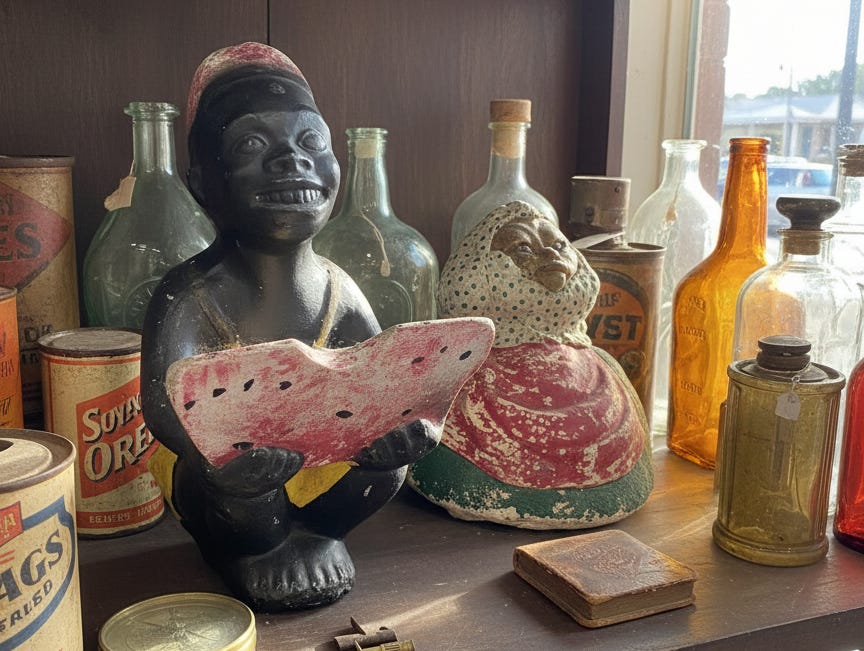
Memory House Antique Shop
Saturday, 7:55 a.m.
Estelle Mason strolled up to the front door, her keys jangling. That was my cue. I stepped out from beneath the coffee shop awning and crossed the street.
“Hello, Estelle,” I said as she pulled out her keys to the Memory House Antique Shop.
She yelped as she turned around to see me standing there. “Mr. Harlow, do you usually sneak up on people while they are going to work?”
She had dropped her key, which I picked up for her because I’m a gentleman.
“Only on the weekends,” I replied with my winning smile. “Sorry for scaring you.”
Her dark brown hair was twisted into neat rows, pulled back from her dark, almond-colored face. A few locs had escaped near her temple, which she tucked behind her ears.
“I’m here to speak with Dolly. I wasn’t sure when she comes in so I figured I would wait,” I said.
“Well, come on in.”
It looked like a typical antique shop. At first glance, there was nothing that would suggest this place had become the center of a cultural firestorm. It smelled of old hickory and ancient history.
All kinds of items displayed themselves on shelves, beckoning the eager customer to pick them up. Rickety old rocking chairs. Dusty old books. The obligatory rooster weather vane.
Hanging on the wall was a painting of an adolescent white girl holding the hand of a small boy with charcoal skin. His blood-red lips stretched tightly into a tense grimace as the white girl appeared to be leading him somewhere.
I was still gazing at it when Estelle’s voice sliced through my reverie. “I’m going to make some coffee and then I’ll be in the office if you need me,” she said.
I gave her a thumbs up.
The section causing all the ruckus was easy to find. Mammy dolls with pitch-black skin. Dinner bells shaped like black maids. I rang one—seemed like the thing to do.
Estelle’s scream was shrill and cut through my thoughts like a hacksaw. The folks in Baton Rouge probably heard it.
I rushed to the source of the scream, which still hadn’t stopped. It was coming from the office.
“Help! Help! Oh my God!”
I hurried to the back corner of the shop, where I had interviewed Dolly days ago. The door stood ajar, begging me to enter.
Dolly was stretched out over a white, patterned rug. She was lying on her back, her limbs twisted in awkward, severe angles.
I almost went for my pistol before I saw the dried blood that encircled her head like a crimson halo. She’d been killed last night, which means whoever did this was long gone.
Her kind, grey eyes were half open. Her jaw hung open in a silent scream. Her blue dress was wrinkled, and one of her green seashell earrings had fallen next to her shoulder.
Without thinking, I touched her wrist. It was cold. My shoulders quaked as I removed my hand.
The murder weapon lay inches away from her head. It was an old statue. A grinning black man with ape-like features and impossibly large lips. He clutched a giant piece of watermelon. Flecks of green, red, and black paint remained on the fruit.
It was as if the killer had used the item that best reflected the controversy.
“The golliwog character became so well known that when others produced this type of art, people referred to them as ‘golliwogs,’ or ‘gollies’ for short,” Dolly had told me during our interview. “That’s how they got their name.”
I remembered feeling like I had taken a trip back to the late 19th century, when pieces like this would have been the norm in a city like New Orleans and across the South.
“This imagery was all over the place back then,” Dolly had told me. “Really though, the fact that so many people find it odious today shows that we have made progress — even if there is still more work to be done.”
She had a point. But it made me wonder how often someone who looked like me could go about town without having society’s scorn shoved in their faces.
I felt fortunate that I would never have to find out.
The smell of blood was so pungent, I could almost taste it. A deathly atmosphere made the hair on my neck stand at attention.
Blood caked on the statue’s face like makeup on a television news anchor. There were no injuries on Dolly’s face, which seemed to indicate the assailant had struck her from behind.
Estelle had finally stopped screaming. Her hands trembled as I took them in my own. “Call the police,” I said. “Can you do that for me, Estelle?”
An unintelligible noise came from her mouth, but she nodded, so I took it as a “Yes.”
After she left the room, I scanned the scene. I knew the police would come through that door any minute, and this would be my only chance to take everything in.
No signs of a struggle. The sparse furniture was arrayed just as I remembered it from the last time I was here. Against the wall, nestled between two oak bookcases, was a desk.
Dolly’s laptop perched atop the desk. Strewn on the desk were various papers. Accounting, bills of sale, nothing special. Perhaps the killer struck while she was working.
My mind raced with theories as to the motive for the crime. I quickly shunted them away — I had plenty of time to put on my Sherlock cap later.
When I interviewed Dolly for my article on the golliwog topic, it was in this very office. I remembered watching her place a bunch of sundry items on one of the shelves of the bookcase to the left of her desk. “I’m just doing some reorganizing,” she had said.
There was a campaign flyer featuring City Councilmember Pierce Lemaine, who was currently on track to win the mayoral race. Also, a nasty letter from a critic. She hadn’t thrown it in the trash yet.
There had been a jade necklace with a heart pendant that looked like it belonged in a pawn shop. She told me she had trouble selling it.
I didn’t see the necklace now, but the letter was interesting. I took a quick picture of the note with my smartphone. In fact, I took pictures of the whole office. The desk. The bookcases. Even the wastebasket.
I snapped a quick picture of the shelf. The necklace was the only item missing, which could mean something.
As it says in the Ace Journalist Handbook: “When you accidentally discover a crime scene, take as many unauthorized photos as possible.”
I don’t make the rules, folks.
“The police are on their way,” Estelle said behind me. “Are you taking pictures?”
“Yes,” I answered confidently.
“Are you supposed to do that?”
“In case the police might want them.”
“Don’t they take their own pictures?”
Before I could explain the finer points of the Ace Journalist Handbook, we heard the front door open. The boys in blue were here to save the day.
Less than five seconds later, Detective Leo Fontenot and several uniformed officers came into the office. He looked at me like I was a piece of bird crap on his windshield.
He was wearing a basic grey suit. Grey trousers. Grey sports coat over a white dress shirt. He was black, but light-skinned — Creole blood. He was a year older than me at 36 years old. He ran a hand through his closely-cropped black hair and adjusted his horn-rimmed glasses.
Fontenot and I have a history. I’m no fan of the police. I’m not a fan of government officials in general.
But Leo and I have known each other since high school, which means I trust him—barely. We weren’t exactly bosom buddies, but we were cordial, usually.
We got along fine until he started wearing the badge.
“Shit,” Fontenot exhaled. “What are you doing here Harlow?”
“Shopping?” I explained.
Fontenot’s eyes darted around the room. “Did you touch anything?” he asked.
“Of course not,” I said.
The detective turned to the uniforms and barked some instructions. He gestured for me to follow him out of the room.
“Am I going to have to take you down to the station, Jackson?” Fontenot said, glowering.
“I interviewed Dolly a few days ago for an article about the golliwog thing,” I said.
Fontenot rolled his eyes. He was probably as exasperated about the whole thing as I was.
“I came back this morning because I wanted to discuss something else with her.” I added.
Fontenot’s gaze never left my face. “What did you want to discuss?”
“Boring journalist stuff. History. Nothing you would be interested in.”
“Did you see anything suspicious?”
“Yes. A dead body.”
Fontenot removed his glasses and rubbed the bridge of his nose with two fingers. I really shouldn’t have been giving him a hard time. But some things are just too hard to resist.
“Jackson,” he sighed.
“I didn’t see anything else out of the ordinary. I came in here with Estelle when she opened the store. She discovered the body. Looks like she’s been dead for awhile judging by the dried blood. Also, the statue is clearly the murder weapon. Has lots of blood on it,” I said.
“Some fine detective work there, Harlow,” he said.
If I didn’t know any better, I’d have thought he was being sarcastic. I did my best to look hurt.
“Does that mean I can have a badge now, Fonty?”
“I told you not to call me that.”
“You did? When was that?”
“Every time I have the displeasure of running into you.”
“I’m thinking it had something to do with the protests. Why else would the killer choose to use that particular statue as the murder weapon?”
Fontenot leaned back against the wall.
“I need a smoke,” he said. He looked tired.
“You want some company?”
“Sure.”
We walked out of the back door into an alleyway. Fontenot fished a pack of Newports out of his jacket pocket and lit one up. He offered me the pack. I shook my head.
“A black dude smoking Newports? Shouldn’t we be trying to break the stereotype, Leo?”
He gave a short laugh. “Sorry I’m not blacking right, Jackson. It’s been a long day.”
“If it makes you feel any better, I’m actually a proficient swimmer.”
“This golliwog thing has gotten out of control. If it turns out the killer did this because of politics, shit’s gonna get even worse. Know what I mean?”
I did. On the day I interviewed Dolly, there was a massive protest outside of her store. While we were talking, someone hurled a brick through the window.
Then, all hell broke loose. Dolly’s supporters clashed with the protesters. The police clashed with everyone. It was by God’s grace that nobody died or was seriously hurt.
“Did you notice anything strange when you interviewed Dolly?” Fontenot asked.
“Other than the chaos outside and the brick through the window?” I answered.
“Yes, other than that.”
“She tried to put on a brave face. But she was worried, and I think it was about more than the protests.”
He took another drag on his cigarette and gave me a look that said, “Go on.”
“She said she’s been getting more hate mail than usual — including death threats. That didn’t bother her because it had become normal,” I said. “But she said she was concerned that she was being watched. She didn’t elaborate.”
“Okay. That’s good to know.”
“You know I have to write this up, right?” I said.
“Of course you do. God forbid you make this easier on me.” he replied. “We just got here. I don’t have any information for you yet.”
“I know. But when you do—”
“Yes, when I do, I’ll give you a call,” Fontenot interjected. “Now get out of here and let me do my job.”
I walked back to my Jeep and caught my reflection in the rearview mirror. At 35, I still looked young enough to get carded occasionally, though the flecks of grey creeping into my goatee suggested those days were numbered.
My dark brown skin showed the first signs of stress—a crease between my eyebrows that hadn’t been there a year ago. I straightened my collar and pulled back onto Magazine Street.
The Bayou Chronicle
9:37 a.m.
I walked across the street and got into my car and drove down Magazine Street on my way to the office.
It was 9:37 in the morning, and the tourist traffic had just begun to pick up. I drove past the usual lineup of boutiques, restaurants, and coffee shops. I patted myself on the back for managing to avoid running over any pedestrians.
Fontenot was right. If it turned out that the killer was motivated by politics, it could lead to even more violence. New Orleans, like the rest of the country, was a powder keg. All it needed was a spark — and murdering an old white lady who people were branding as a racist would be the perfect match.
No matter how this went, things were going to get ugly.
I thought about my interview with Dolly days before. It was my first time meeting her. She was a kindly woman — a little over 80 years old. But she was tough. I couldn’t help but admire her resolve.
“This is NOT about racism,” she told me. “It’s about history. All of it. The good, the bad, and the ugly.”
What truly impressed me was Dolly’s refusal to vilify her detractors.
“What about the people calling you a racist?” I asked. “What do you think of these people?”
“I think they are misguided — and I can hardly blame them. When you have people in positions of power telling us to hate each other, it’s not easy to avoid getting swept up in the hate,” she said. “They think I’m evil. But I bet if they actually got to know me, they would think differently, even if they still disagreed with me.”
The sordid history of golliwogs has largely gone under the radar. Many shops had been selling these relics for years. But when activists began posting pictures of these items on social media, talking heads and online influencers couldn’t wait to pounce on the opportunity to use them for clicks.
When I interviewed some of the protesters, most couldn’t even tell me the history behind these artifacts. They just knew they were hateful, and that’s all that mattered. But would any of them resort to murder?
I couldn’t discount it.
I pulled into the parking lot of The Bayou Chronicle, my home away from home.
I made my way toward Mavis Carroll’s office. She’s my editor.
“What’s up Jax!” a voice said behind me.
I turned around and saw Charlie Liu, our IT manager, standing in the hallway.
“What’s good, Liu?” I said.
“Just making sure the trains are running on time,” he quipped.
Liu was young, about 25 years old. He was Chinese American. His parents came to the United States back in the 1990s with only seven dollars to their name. At least that’s what he’s told me about a million times.
He was skinny, of average height, and looked like he spent most of his spare time playing tabletop role-playing games.
He was a bit socially awkward, but the kid is a wizard with computers. I mean a Dumbledore/Gandalf level of wizardry. He had started at The Chronicle about six months ago, and our systems had been running like brand new.
“I’d love to chop it up with you, but I need to see Mavis,” I said.
“Okay then, I’ll catch you later.”
I walked into Mavis’ office. She was on the phone, but I’m a patient guy, so I waited.
Her office was what some might describe as “homey.” A comfortable brown couch sat on the left wall. I typically avoided it because it was known to cause unwitting victims to fall asleep three seconds after their butts hit those cushions. The scent of lavender wafted throughout the room, betraying Mavis’ penchant for essential oils.
The wall was littered with various awards the news outlet had won over the years. Mavis’ desk was almost completely bare, except for her laptop and several pictures of her laughing husband and smiling kids — who were now adults.
“Okay, I’ll let him know,” Mavis said into her phone before hanging up.
She looked at me.
“So, I heard you had a ‘Law & Order’ moment this morning,” she said.
“Huh?”
“You know. Law & Order. Every episode starts with someone randomly finding a dead body.”
“Yes, but without a ‘chung chung’ noise, I hardly think it counts as a Law & Order moment. How did you know, anyway?”
Mavis was in her early 60s. She’d been in the news business since before the printing press was invented. She was slightly overweight due to her penchant for sweets. She had pale skin and a Mrs. Buttersworth’s face that could easily turn scary when the situation demanded it.
But, as they say, appearances are deceiving. She was a no-nonsense hard-nosed newswoman, and she did not suffer fools lightly — especially those who underestimated her.
“Your friend at the NOPD called me.”
“Yeah? What did Fonty want?”
“He informed me that he doesn’t want you getting in his way.”
I put my hand to my chest as if I were aghast at the very suggestion. With my most wounded look, I said, “Why would he ever say such a thing?”
“I have no idea, especially since Mercier was just discovered and you haven’t written a single word about it yet. Are you waiting for The Times-Picayune to scoop you?” she asked.
“What did you tell Fonty?” I asked.
“I told him to mind his own business. He told me to tell you to give him a call when you get a moment. I’m telling you that moment is now, I want that report on our site yesterday.”
“Aye aye, captain!” I saluted.
I went to my desk and called Detective Fontenot.
“Harlow.” Fontenot answered.
“Fonty,” I replied.
“The investigation is still in its early stages. But I have some information for you.”
This wasn’t right. Normally, getting information out of Fontenot was like trying to win a tennis match against a brick wall. I believe his first words as an infant were “no comment.”
“I’m listening,” I said.
“Dolly had been receiving death threats in the days leading up to the murder. More so than usual.”
“And?”
“Our initial assessment is that the murder happened at about nine-thirty last night. She died of blunt force trauama after the killer used that statue to bludgeon her to death.”
“Any suspects?”
“Not yet.”
“So, what are you not telling me?”
“No comment.”
There it was.
“How about off the record?”
“All I’ll say is that if you’re looking for something for your story, you might want to talk to Estelle Mason.”
“The lady who works there? Makes sense.”
I decided to circle back with Ms. Mason when she was ready to talk.
“Also, Pierce Lemaine has been informed of the murder. It happened in his district. He will be giving a press conference later today. Better get that article out. You don’t want to get scooped by a politician, do you?”
No, I didn’t. I bade Fontenot farewell and got to work.
I had the article completed in less than fifteen minutes because I’m that damn good. Of course, it was all preliminary information. I was in this for the long haul, so I knew I’d be writing plenty more updates about this story.
The question was, should I hit up Estelle first? Or attend this press conference. I decided on the latter. Estelle would still be in shock from what she saw that morning.
Memory House Antique Shop
11:45 a.m.
The press conference was to be held in front of Memory House Antiques — the crime scene. I got there early because I had nothing better to do.
As other reporters began to show up on the street in front of the store, I scrolled through social media to see the chatter about the case.
“The old racist bitch is dead? Good riddance,” one user wrote.
A well-known left-leaning influencer wrote, “We don’t know what happened here. We should wait for the facts to come out. But we definitely shouldn’t be celebrating murder even when it happens to people like Dolly Mercier.”
I read several posts from those on the other side claiming Mercier’s murder was politically motivated. “This is what the woke left does,” one user wrote. “They use violence to silence people who don’t agree with them.”
Many people had shared my article, trotting out the usual talking points coming from their chosen team.
I knew this was only the beginning. I suspected the killer was motivated by politics. There would have been no other reason to murder Dolly. Nothing had been stolen, so robbery was out of the question.
There was also the choice of murder weapon. There were plenty of items in that shop that would have been a better instrument. Lamps. Frying pans. Hell, the murderer could have brought his own weapon.
Instead, he smashed Dolly’s head in with a heavy golliwog statue and left it next to her body.
What else could it be?
My phone rang. I answered it.
“Mavis! Guess where I am,” I said.
“I don’t know, but I know where you better be.”
“I’m at the press conference.”
“And that’s why you’re my favorite. Don’t tell the others.”
“Aww, I bet you say that to all your ace reporters.”
“Maybe I do. Anyway, I wanted to ask you to get an interview with Councilman Lemaine after the conference if you can. It would be nice to get him on record.”
“Do I have to?”
“Yes. You’re a journalist, remember? Talking to politicians is part of the job.”
“Sometimes I forget. On purpose.”
I pounded the pavement toward the front of the shop so I could get a good angle of the press conference. A few other reporters showed up, trying to do the same. We looked like spectators trying to find the best seats for a free concert.
“That’s because you hate politicians, which is why you’re such a good journalist.”
“I must be a piece of toast, because I can feel you trying to butter me up.”
“If you don’t get that interview, you WILL be toast.”
“Touché. By the way, Fonty gave me some interesting tidbits. I’m going to get Estelle Mason on the record if I can.”
“Sounds great. I’ll talk to you later.”
I hung up. The press conference was starting.
Detective Fontenot was first.
“You’ve all heard by now that Dolores Mercier is dead. I’m here to tell you that NOPD has opened up a murder investigation. She died at about nine thirty last night and was discovered this morning at nine o’ clock,” Fontenot said.
He still looked tired, but seemed more energetic after getting some caffeine into his system.
“She appears to have been bludgeoned to death with a heavy blunt object, but we have not yet obtained the autopsy results. We are urging caution, but we want you to know that we will apprehend the person who did this. There is no reason for panic. We will update you when we have more information. Now, I’d like to allow councilman Pierce Lemaine to offer his thoughts.”
Fontenot waited for Lemaine to come to the podium. He looked almost relieved, but he knew he would be fielding questions from nosy reporters like me later.
Lemaine shook Fontenot’s hand and turned to the microphone.
“First, I want to extend by deepest condolences to the family of Dolly Mercier. I can’t imagine what it must feel like to have a beloved family member taken from them in such a gruesome manner,” he said, his voice breaking slightly. “I ask all New Orleanians to join my wife and I in praying for Dolly’s loved ones in this time of tragedy.”
Lemaine was tall, a little over six feet. He wore an expensive navy blue suit over a white dress shirt, a red power tie, and an appropriately somber expression.
He was a black man, 52 years old, and had risen quickly through the political ranks in New Orleans. He had kind, but penetrating brown eyes. In other words, the quintessential politician.
“This atrocious act of violence will not go unpunished. I have faith in our good men and women in law enforcement,” Lemaine said, his voice rising. “But even more, I have faith in the people of New Orleans. These senseless acts do not define us. We do not murder people over their political views. This is not who we are.”
The crowd was so silent that if someone had dropped a grain of sand on the pavement, we would have heard it. This guy was good — real good.
“When I am mayor, I will work tirelessly to ensure that this does not happen again. Nobody should ever lose their life over politics,” Lemaine said.
Lemaine already assumed Dolly’s murder was political, even though the police had not publicized a motive yet. Perhaps he was thinking what I was thinking.
“I won’t take up more of your time. But I will assure you that Detective Fontenot and the good people in the NOPD have this well in hand,” Lemaine concluded.
Short and sweet. This man had politics in his DNA.
Fontenot stepped up to the podium once more and invited questions. Normally, I would join the other reporters in questioning the detective, but I knew he would simply repeat his favorite words: No comment.
Instead, I made a beeline for Lemaine as he walked toward a waiting vehicle.
“Councilman Lemaine,” I shouted, getting his attention.
He turned around and looked at me, a look of recognition spreading over his face. He gave a smile bigger than the Cheshire cat’s. “Jackson Harlow, is it? With The Bayou Chronicle?”
I raised my hands in mock surrender. “You got me.”
Lemaine laughed, not just with his mouth, but with his whole face. “What can I do for you?”
“I wanted to ask you a few questions.”
One of Lemaine’s staffers stepped between us. He was a slender, tall white man wearing black trousers and a powder blue dress shirt. “The councilman is not taking questions at this time, sir.”
I knew him. His name was Theo Guidry, a longtime staffer for Lemaine. But I could tell he was more than that. In fact, I know a fixer when I see one, and they usually don’t look like Olivia Pope from that wretched TV show.
“Theo, it’s fine,” Lemaine said. “I’ve read Harlow’s work. He’s a straight shooter.”
Guidry nodded and walked back to the car. Lemaine gestured for me to follow him.
We both got into the limo. I sat across from Lemaine, who made himself comfortable and opened a bottle of water. He offered me one. I said no thanks because I didn’t want to get politician cooties.
I didn’t really say that last part.
“What can I do for you Mr. Harlow?”
“Call me Jackson.”
“Call me Pierce.”
“I noticed you indicated that Dolly’s murder was politically motivated. Do you know something the rest of us don’t?”
“You don’t like me very much, do you?”
“I don’t know you.”
“Yes, but I’ve read your work. You’re not exactly a fan of politicians are you?”
“I’m a fan of the truth, something that gives most politicians hives.”
Lemaine laughed again, and he seemed to mean it.
“I can’t blame you for your skepticism. I think it’s well earned in most cases. I will be the last person to say I’m anywhere close to being perfect.”
“Who would be second to last?”
“My wife.”
He chuckled again.
“I could sit here and try to convince you that I’m different. I could tell you that I’m dedicated to bettering this city. I won’t waste your time. I’d rather my actions speak for themselves,” he said, straightening his tie. Instead, I’ll just tell you that Fontenot gave me some of the details of the crime scene. The killer used that racist statue to kill her, right?”
“Yes.”
“Then I think the message is clear.”
“Seems to be.”
Lemaine downed the rest of his water and placed the bottle into a trash compartment.
“I know you’re skeptical. But I meant what I said. This country has become way too divided,” he said, his expression intensifying. “I can’t tell you how many of my constituents have told me they cut off family members, or were cut off themselves just because of politics.”
He sat back in his seat. Suddenly, his tone became more weary, resigned.
“Sometimes I don’t think there’s a way out of this. I certainly don’t know what to do about it,” he said. “But, for what it’s worth, I can use my platform to try to convince people to come together. What happened to Ms. Mercier is heartbreaking, even though I personally did not agree with her choices.”
Lemaine looked at his phone. His expression turned grim.
“I look at social media — I know I shouldn’t — and all I see is people attacking each other. What happened to the belief that we’re all Americans? I remember a time when we all came together after 9/11.”
He paused, as if he were remembering. The frustration etched itself onto his clean-shaven face.
“I don’t know what it will take to get back to that. But I think people like you are the key. You don’t have an agenda. I don’t even know who you voted for in the last election,” he continued. “I know we’re from different worlds, but I believe you and I want the same thing.”
“I hope you’re right,” I said. “Thanks for your time.”
I moved for the door. Lemaine said, “hold on one second.”
I stopped.
He fished out a business card from his suit pocket. “If you need anything, here’s my personal cell number. I want to help in any way I can.”
I took the card and left.
He was good. Almost too good. I’d seen it many times before — the kind of charisma that had been honed over years and years of politicking, glad-handing, elbow rubbing, and everything else.
But — he seemed sincere. I hadn’t heard anything too negative about him over his political career.
I didn’t trust him. But I didn’t distrust him either. His conviction seemed genuine enough. As he said, his actions would tell me everything I need to know.
The Harlow Residence
5:00 p.m.
I decided to call it quits for the day. Between discovering Dolly’s corpse, writing a frantic report about her murder, and cavorting with a politician, I felt I’d paid my dues — at least until tomorrow.
Lemaine had given me more questions than answers—and I needed time to think through the events of the day. Or maybe I just needed a beer. Two things can be true at once, right?
On the drive home, I reflected. I had no doubt that politics motivated the killer to target Dolly. It was a shame. She seemed to be a decent woman. I realized I hadn’t had time to process what happened to her.
I couldn’t get the image of her vacant expression staring up at the ceiling. Estelle’s scream still echoed in my mind like a persistent ringing in the ears. Even more, I considered how this might affect an already-tense political climate in New Orleans — and across the country.
I pulled into my garage, walked into the house, grabbed a beer, put on some Coltrane on the Bluetooth speaker, and plopped down on the couch.
I pulled out my phone and called Mavis. “Jackson,” she answered.
“I think it was political, Mavis.”
“I’m doing well, how about you?”
“I’m just dandy.”
“Jackson, I’ve known you for over a decade. You think I don’t know when you’re lying?”
“Dolly didn’t deserve that. I don’t understand why selling antiques could motivate someone to murder.”
I got off the couch and grabbed another beer.
“You liked her.”
“I didn’t know her that well.”
“When has that ever mattered to you?”
“Touché. Want to tell me what I’m thinking now?”
“You want to find out who did it.”
“I do.”
“Just let the police do their jobs, Jackson. You’re a reporter, not Philip Marlowe.”
“But our last names rhyme.”
“Fontenot had a point earlier. They will handle this. Just let them work.”
“Yeah, because that always works out so well.”
I could hear her scowl through the phone.
I smiled. “Don’t worry boss lady. I’m just here for the story.”
“Let you tell it,” Mavis said before hanging up.
I took a sip of beer as I opened up the Twitter/X app. I wanted to see what the chatter was like — and it was exactly what I expected. The murder was trending.
Some influencer posted a video in which she claimed the Deep State, in conjunction with the Mossad and the Portugese government, had orchestrated the murder, but couldn’t yet tell us why. She was just asking questions, after all.
There was a video clip of a generic white-haired talking head ranting about how “If it had been a black victim, we’d be hearing about it all over the legacy media” even though I’d already seen it in several mainstream outlets.
My phone buzzed. I picked it up without looking at the screen. I figured it was Mavis calling me back.
It wasn’t.
“Hello, Mr. Harlow,” the caller said. The voice was distorted and metallic. It sounded almost like Darth Vader. The caller was using an app to disguise their voice. I couldn’t tell whether it was a man or a woman.
My heart jumped a beat.
“Good evening. Who is this?” I answered.
“An ally.”
“Does my ally have a name?”
“I read your article on Dolly Mercier’s murder. In fact, I’ve read a lot of your work. You could say I’m a fan.”
“Are you about to tell me to go to the pharmacy and buy some gift cards?” I said.
“What?”
“You know, like those scams.”
The caller paused, as if trying to decide how to answer. They eventually decided to ignore my joke.
“Aren’t you curious about who killed that racist bitch?” the caller said.
It was almost certainly a prank. But I was bored, so I played along.
“Sure. But before you tell me, do me a favor, say ‘You don’t know the power of the Dark Side.’”
“You’re not taking me seriously, are you, Mr. Harlow?”
“Of course I am. The fate of the galaxy is at stake.”
“I bludgeoned her to death with that racist statue. Left her staring at the ceiling while the blood flowed out of her head.”
A sat up straight. With a few flicks of my finger, I turned on the recording app. The only people who knew about the murder weapon were a few police officers and Pierce Lemaine, who definitely didn’t commit this crime — probably.
“I’m listening.”
“I have your attention now, Mr. Harlow?”
“I said I’m listening.”
“She had it coming. She was warned. But she wouldn’t stop.”
I needed this person to make a mistake, one that could help me identify them. But I didn’t want to spook the caller, so I played it cool.
“Seems to me she was just selling old relics. Was that worth killing over?”
“You’re a black man, Jackson. Are you really gonna defend that bitch? Of all people, you should know how problematic she was.”
He was picking up speed, getting excited. Exactly what I wanted.
“I know a lot of people were offended. I can understand why. They represent an ugly era in our history.”
“Yes, yes. Exactly.”
The caller’s voice was rising now.
“She could have donated them to a museum, or threw them away. But she didn’t,” said, leading them on.
“Right. And she wasn’t going to stop — and it gets even worse, Mr. Harlow.”
“Go on.”
“She was working with the Aryan Nation.”
“The white supremacist group?”
“Yes, the white supremacist group.”
The Aryan Nation was a gaggle of disaffected white youth who believed their race was under attack. Their list of enemies included the usual suspects: The blacks, the Jews, and the Messkins.
They weren’t the usual toothless, inbred, Bud Light swilling hicks. Most of their activity was online, where they tried to present a more palatable image. They wore nice suits and ties and engaged in online debates.
My stomach tightened. If this was true, it would mean I’d been defending a whole white supremacist. I made a mental note to follow up on this later.
“She was helping them organize a rally in New Orleans. I’ve got proof,” the caller said.
“The Aryan Nation are feckless imbeciles. They rally all the time. As far as I’ve seen, they’re not the violent type.”
“You’re missing the point, Mr. Harlow!”
They were becoming more agitated now. Good.
The caller continued, “Do you know what kind of damage a rally like that could cause right now? They plan to escalate. The residents of New Orleans shouldn’t have to deal with these pricks waving their swastika flags in the streets!”
I decided to take a gamble.
“What’s your name? Maybe we could meet up and talk about this.”
“Do you think I’m a fucking moron Harlow?”
“Just thought I’d give it a shot. What should I call you?”
“You still think this is a joke?”
“I don’t. But this conversation would be easier on me if I had a name. How about Lord Vader?”
“Fuck off.”
“Why did you call me, anyway? There are plenty of other black journalists you could have bothered.”
“Like I said, I’ve read your work. I’m a fan — even if I think you ride the fence too much for my tastes. You’re fair, and I think you might understand more than those other hacks.”
“I’m flattered.”
“I’ve got to go. We’ll talk again, Mr. Harlow.”
“Does this mean you’re going to kill someone else?”
“Good night, Mr. Harlow.”
The line went dead. Well, I tried.
I called Detective Fontenot. His voice mail message greeted me. I tried again. No luck. I sent a text message telling him to call me as soon as possible.
I knew then that this was going to get even uglier. I gazed down at my phone, the recording app still running.
The killer's distorted voice was frozen on the screen, a flat line. I had a feeling this wouldn’t be my last conversation with my new acquaintance.
Click for Episode 2: Pointed Fingers and Comfortable Lies
Read Jackson’s report on the Golliwog Controversy here.
This is amazing and different. HOOKED. Does Harlows have a girlfriend? 👀