


The Vasquez Residence
Friday: 9:00 a.m.
I thought the rest of the paint would chip off as I knocked on the front door of the Vasquez residence. The double shotgun house had seen better days, but still managed to survive in Mid-City New Orleans.
I’d known the Vasquez family since high school, and the yellow and teal paneled home hadn’t changed much in over two decades. The bars on the front window mirrored those of the rest of the neighborhood, denying entry to the bad crowd and quietly showing visitors what kind of neighborhood they were in.
Imelda answered the door. She was a handsome woman. Hispanic, stout, with a smile that felt like a warm fireplace in the winter. But today was different.
Her eyes were bloodshot and the puffiness told me she had been crying. “Jackson. I’m so glad to see you. Thanks for coming.” she hugged me tight and didn’t let go.
I could feel her sobs before I heard them.
She broke the hug after a few seconds. “I’m sorry. I’m being rude. Please come in,” she said, choking down more sobs.
“No, it’s okay. I got here as soon as I could,” I said.
The inside of the home fared much better than the outside. Imelda always took pride in creating a warm atmosphere. It smelled faintly of spices, which provided any visitor with a preview of what to expect if they were lucky enough to have one of her home-cooked meals.
Imelda had called a half hour ago, frantic. She was so upset she struggled to tell me what had happened, only that her son Steve Vasquez was in trouble.
“Please, have a seat. Do you want anything to drink?”
“No, I’m good, thanks.”
I sat down on a worn brown couch. Imelda sat next to me. She was in her early 50s, but looked like she was barely turning 40. Still, the worry lines on her face revealed her struggles — and her toughness.
“Jackson,” she began in accented English. “Steve is in jail. They say he killed someone.”
The stress inflated in my chest like a hot-air balloon.
“What happened?”
“Police showed up last night...I think there were ten men with rifles and body armor...I didn’t hear them knock, just boom!”
Having reported on corrupt policing for over a decade, I could easily predict what Imelda would tell me next.
“They broke through the door and came in screaming,” Imelda said, fighting the tears back. “Two of them pinned me to the ground while the others looked for Steve.”
I imagined the scene, screaming officers holding Imelda down. The stress balloon in my chest turned into fury.
“Where was Bianca?” I asked. She was the youngest child, about 11 years old.
“She was sitting where you are now, reading,” Imelda said. “They left her alone. They wanted Steve.”
At least the officers didn’t give Bianca the same treatment they gave her mother. Still, the sight of armed men bursting into her home would traumatize adults. I couldn’t imagine how it affected Bianca.
“Okay. What happened next?”
“They...they brought my son out of the kitchen and threw him to the ground. They searched him and said he was under arrest for murder.”
Imelda’s breathing quickened to the point I was concerned she was hyperventilating.
“Did they say who the supposed victim was?”
“Yes, but I don’t remember his name.”
“I’ll check with the police. Do you know where they are holding him?”
“Orleans Justice Center.” Her voice was raw, as if she’d been screaming nonstop for hours. I took her hands in mine.
“Have you spoken to the police since they arrested Steve?”
“I..,I tried to tell them he was a good boy,” Imelda replied trying to keep her breathing in control “He would never kill anyone...he was getting his life back together—” she couldn’t finish the sentence.
The tears came again, but she still kept what was left of her composure.
I knew why she had called me. Of course, the police wouldn’t take her seriously. Their job was only to arrest who they were told to arrest. That’s how the system works.
“I didn’t know who else to turn to. You know more about this stuff than I do. We can’t afford a lawyer.”
“I’m glad you called me, Imelda. I will do everything I can to figure this out. Does Hector know?”
Hector “Hex” Vasquez was Imelda’s oldest child. He was in his mid 20s now. To say he ran with a bad crowd would be like calling Mt. Everest a hill.
“He’s on his way.” Imelda’s brow furrowed. “Can you talk to him? He was so angry, I’m afraid of what he might do.”
I understood. I waited with Imelda until we heard the sound of a car pulling into the driveway. Seconds later, Hector opened the door, which was easy since the police had broken it during the raid.
“Mom, what the fuck happened? What did—”
Hector stopped when he saw me.
“Jackson? What are you doing here?” he asked.
Imelda answered for me, “I called him after I talked to you. He’s going to help Steve.”
Hector nodded. “I appreciate that brother, I really do. But I got this handled.”
He wore a blue flannel and khaki work pants. He was about six feet tall and lanky. Tattoos covered his arms.
“Handled?” I asked. I knew exactly what he meant, but I figured I’d ask anyway.
“Yeah, me and my boys are gonna figure out who did this shit to Steve and we’re gonna deal with them.”
That’s what I was afraid of. Hector was the leader of the 509ers street gang. They dealt in low-level drugs. They weren’t the biggest gang in New Orleans, but they were active enough to be considered dangerous.
“Hector, I know you’re pissed,” I said. “I am too. But whatever you’re planning is only going to make it worse.”
“Well, what the fuck are you gonna do, write an op-ed?” Hector snapped.
“Mijo!” Imelda yelled. “Please...Listen to him.”
I knew it wasn’t personal — and I also knew what Hector could become when he was angry. I tutored him and Steve when they were still in elementary school. They had looked up to me in a way.
“There are better ways to go about this,” I said. “We know Steve couldn’t have killed anyone. The key is proving it.”
“Fuck that,” Hector said. He dropped into an easy chair. He stood again and started pacing. “All these pendejos will see is a Mexican killer. You’re a black man, Jackson. You know how they see us.”
“I don’t disagree,” I said. “But the safest way for Steve — and you — is to beat them at their own game. I’ve seen it happen. They aren’t all powerful.”
“Fuck you, Harlow. You ain’t seen what I seen in these streets. It’s easy for you to say in your nice cushy office.”
That was it.
I stood. It only took me three steps before I was in Hector’s face. He flinched slightly, but didn’t back away.
“Fuck me? That’s how you wanna play it Hex?” I growled. “I’m here trying to keep your sorry ass out of jail. It’s bad enough that your brother is getting railroaded. You think your mother wants to see you behind bars too dumbass? Or are you only thinking about yourself?”
Imelda let out a sob, but composed herself.
Hector didn’t respond, but the gears in his head were turning.
Finally, he said, “Fine. We’ll try it your way. But if it doesn’t work, I can’t make any promises.”
“That’s all I ask,” I said. My eyes never left his.
Hector walked past me and sat down next to Imelda, who had begun crying again. He put his arms around her.
“It’s ok mom. It’s gonna be ok,” he said.
He looked at me. “I didn’t mean all that shit I said,” he said. “You know I respect you.”
“I get it. But it’s still raw. I get it. But we have to do this in a way that keeps everyone out of the system.”
“I hope you can do something. I know you got connections,” Hector said.
“I’m going to visit Steve. You want to come?”
“I’m going to stay with mom. Tell Steve I’ll be by later. Let me walk you out.”
I said goodbye to Imelda and assured her I would be in touch. Hector followed me to my Jeep.
“Hey man, I didn’t want to say this in front of mom. I’m gonna do this your way. But the streets are already talking,” he said. “When they find out Steve got popped for some shit he didn’t do, I don’t know how long I can hold them back.”
“Just do your best. We still have no idea what happened. For all we know, their case is weak and Steve could be out sooner than later,” I said.
“I hope so. But if you need my help on anything, you got my number.”
“I do. I’ll talk to you later.”
We shook hands and did the bro hug and I climbed into my Jeep.
Orleans Justice Center
Friday: 11:42 a.m.
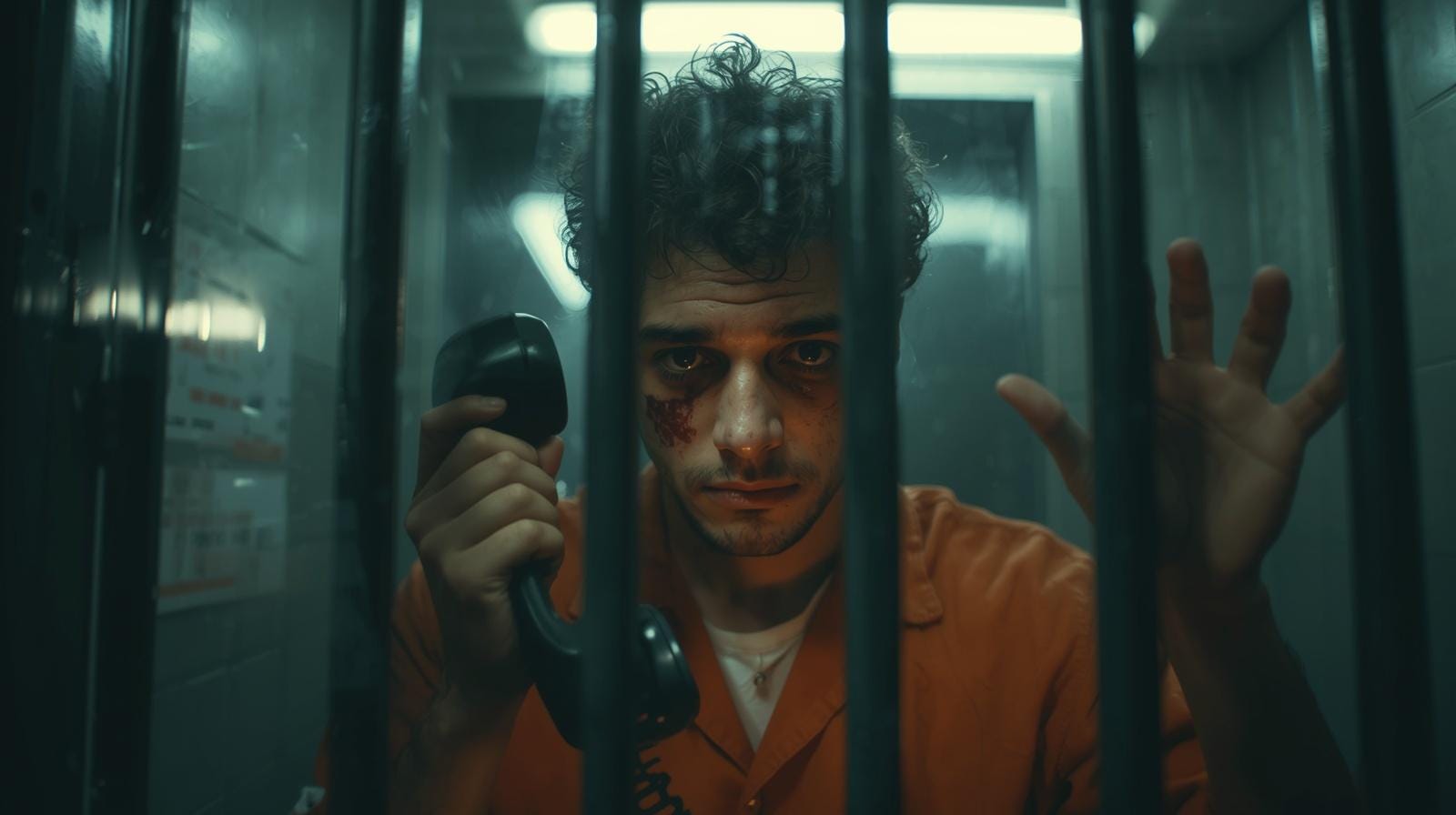
It took a little over an hour sitting on a plastic chair under bad fluorescent lights, but eventually a deputy called Steve’s name and walked him to the booth and lowered him into the chair behind the glass.
He looked about as I’d expected. His eyes widened as he walked into the room and saw me sitting on the other side. They were red, which told me he hadn’t slept. He ran a hand through his dark curly hair. At 19 years old, Steve looked like any other kid with his whole life ahead of him. But now, his future was uncertain.
Steve picked up the phone on the other end. “Jackson? I haven’t seen you in a minute. What are you doing here?”
“Your mom called me. Told me what happened. How are you holding up?”
“I don’t know man, I confused.” He straightened a little in the chair. “But I’m hanging in there, y’know?”
After being friends with Steve and his family for years, it was obvious to me he was trying to put up a strong front. But his quivering hands told me a different story.
“Hector told me to tell you he will come visit later today.”
Steve nodded.
“Steve, I want to help. Tell me what happened.”
“Jackson, you’ve known me since I was ten. You know I didn’t shoot nobody I—”
I put up a hand. “You don’t have to convince me Steve. But you might have to convince a jury. If I’m going to help, I need you to tell me everything you know.”
He sat back in his chair, trying to collect his thoughts. His shoulders slumped as if he were carrying St. Louis Cathedral on his back.
“They interrogated you last night, right? What did they say?”
“Those cabrones think I shot some guy named Julian...Julian Vane?”
“Who is Julian Vane?”
“I dunno man. I think he work at a rehab facility or something.”
I filed the name away for future reference.
“They said I killed him in some drug deal gone wrong,” Steve said.
“I have to ask. Was this a drug deal?”
Steve recoiled, as I’d just insulted his mother. His face darkened and redness formed under his skin.
“Fuck no, man. I ain’t in that shit no more. I didn’t kill him.”
I put up a hand again. “Steve, I’m not interrogating you. I’m just getting the facts.”
He let out a long breath and folded his hands on his lap.
“Sorry. It’s just...I never even met the guy, y’know?”
“I get it. Did they tell you what evidence they have?”
His eyes turned toward the table in front of him, which told me I wasn’t going to like what he said next.
“They found my gun in his apartment. With my fingerprints on it.”
I nodded, maintaining my poker face. “Go on,” I said.
“They also found his gold chain and wallet in my car.”
A knot began forming in my stomach. This already wasn’t looking good. Still, I knew he wasn’t guilty.
“The police said my truck was caught on surveillance footage near his apartment.”
“Was your truck stolen?”
“No.”
I paused, which Steve interpreted as doubt.
“I didn’t do it,” he said, his voice barely above a whisper.
“Steve, I know you didn’t do it,” I said. “I’m on your side—but is there anything you’re not telling me? I can’t help you unless you tell me everything.”
“That’s it. There’s nothing else — at least not that I can remember.”
I paused to think. Steve’s gun was found at the crime scene with his fingerprints on it. Most killers would have at least tried to hide the murder weapon somewhere. But sometimes people panic, drop the weapon, and the flee the scene.
But something wasn’t right.
“Steve, could someone have stolen your firearm?”
“Maybe. But I don’t think anyone broke into my truck — that’s where I keep my piece.”
“When did you notice it was stolen?”
A sheepish look crept onto Steve’s face. I knew what it meant.
“You didn’t notice it was gone, did you?”
“Look man, I kept it under the passenger seat. I never use it so I forgot it was there for awhile. I have it for protection, y’know?”
I resisted the urge to lecture him on responsible gun ownership. I thought I’d drilled that lesson into him when he first started carrying.
“When did the murder happen?”
“About a week ago, I think.”
“So, if someone stole your gun, it would have been at least a week ago. You keep your truck locked, right?”
“Yeah, man.” He looked at me as if I’d asked if he knew how to tie his shoes.
“What about the gold chain?”
“I didn’t know it was even in my truck. I bet someone planted it there.”
As far-fetched as it sounded, I thought so too. But how? When?
I knew time was running out, so I asked, “We will probably have to pick this up later. Have you spoken with an attorney yet?”
He snorted. “Yeah, I guess you could say that.”
“What’s his name?”
“Carl Brady. But he’s useless. He’s already telling me to take a plea deal. He thinks I did it.”
I wasn’t surprised. Most public defenders are overworked, with cases piled ceiling high on their desks. They didn’t have the time to mount a viable defense. And many might as well be prosecutors for all the good they do their clients.
“I’ll talk to him. See what I can find out and if I can get him to take this seriously.”
The door opened and a guard stepped in. Time was up.
“I gotta go. Please tell mom I’m okay,” Steve said.
“I will. Hang in there. I may have some tricks up my sleeve.”
He flashed a weak smile and drifted out of the room.
Public Defender’s Office
Friday, 12:30 p.m.
I sat across from Carl Brady, his worn faux wood desk separating us. I was waiting for him to finish up a phone call. He slouched in his chair and gazed at his desk, listening to the caller. The bags under his eyes could have carried enough water to fill the Grand Canyon.
The call finally ended. He looked at me. “What can I do for you?”
“My name is Jackson Harlow. I’m a journalist with The Bayou Chronicle. I want to ask you some questions about the Vasquez case.”
He leaned forward in his chair. “If you’re a reporter, then you understand I can’t tell you much. Confidentiality and all that.”
His face was the color of an apple, which told me he’d consumed copious amounts of bourbon in his lifetime.
“I know. Just tell me what you can, if you don’t mind. Steve’s a friend.”
“Well, he’s not doing himself any favors, I’ll tell you that.”
“What do you mean?”
“His gun was in the victim’s house. The victim’s gold chain was found in his truck. The investigators say his truck was near the crime scene.”
“He told me.”
“Then you know about as much as I can tell you.”
“What do you know about the victim?”
Brady shuffled some papers around on his desk. He picked one up and read from it as if he were reading the charges to a jury.
“Julian Vane. Age 39. Lived in the Garden District.”
“He had money, then.”
“Apparently. He works for The Sanctuary Network. It’s a drug rehabilitation center.”
The Sanctuary Network had a stellar reputation. It’s founder, Cassandra Rose, and I had a two year-long fling a long time ago. We had bonded over our opposition to the war on drugs. Her organization embodied the notion that addiction should be treated as a health condition, not a crime.
I decided not to let on what I knew about the place.
“The Sanctuary Network? I asked.
“Yeah. That’s where they send all the druggies. I’ve heard some good things about it.”
“Steve said he didn’t know the victim.”
“I’m sure he did.”
“You think he’s guilty, don’t you?”
“You—you know I can’t tell you that.” he hesitated. “The DA’s office is already talking plea deals. I told Steve he should take it. He might be released by the time he’s 45.”
I was less than shocked. This guy wasn’t going to fight for Steve. He’d already written him off. I didn’t think I could get anything useful out of him. I thanked him for nothing and left.
I walked across the parking lot to my vehicle. As I approached my Jeep, I heard the sound of footsteps hitting gravel behind me.
“Jackson Harlow?”
I turned around and saw a man wearing a grey blazer, white dress shirt, and grey slacks. But he might as well have been wearing a uniform, because his entire manner screamed police officer.
“Yes, that’s me.”
He was gnawing on gum like a beaver on a piece of wood. He was mid-height, probably late 40s, his dark hair greying at the temples. His clothes were at least one size too big for him.
“I read your stuff sometimes. Its not bad, even though I think you could go easier on law enforcement,” he said.
“Is this where you tell me there’s only a few bad apples and I shouldn’t imply that they represent all police?”
He gave a short laugh and put his hands up like he was guilty. “Nah, not this time.” He spit the gum onto the ground and retrieved another piece from his pocket.
“I’m Ray Dufresne. NOPD. I work narcotics.”
I had heard of Ray “Razor” Dufresne. He was something of a star to the “tough on crime” crowd. He won several awards for bringing in drug dealers and users. It was almost like he had a sixth sense when it came to finding and busting those who ran afoul of the law.
“How can I help you, detective?”
“I was curious. It’s not every day we get a visit from a journalist of your caliber.”
“Well, someone has to keep y’all on your toes.”
Dufresne’s laugh sounded like air traveling through lungs lined with sand. His yellow teeth told me he was a heavy smoker.
“I suppose so. But if I had to guess, you were here to visit the Vasquez kid, right?”
This wasn’t a guess. Dufresne could have easily found out who I spoke with. I let him continue.
“I knew that kid from when he was slinging dope down in Mid City. I saw the evidence against him. He’s going down, partner.”
Dufresne rubbed his chin, looking like he’d place my king in checkmate.
“For starters, it’s been five years since he was selling weed — and only weed,” I said.
“Yeah but—”
“Secondly,” I interrupted. “I’ve known Steve since he was in elementary school. You got the wrong guy.”
“You know we found his gun in the victim’s apartment, right?”
“Yes. And I know about the gold chain too.”
Dufresne’s spread his arms as if to say, “See? I told you so.”
“But,” I said before he could cut in. “This is New Orleans, where the boys in blue don’t always play things by the book. That alone is enough for me to question whether there is more to this story.”
Blood rushed to Dufresne’s face. I don’t normally like to antagonize cops. But this man’s undeserved swagger annoyed me.
He swallowed his anger and said, “I’m pretty sure everything was done properly in this case — unless you have evidence?”
“Well, I just got started,” I said. “So if there is something to find, you better believe I’ll find it. If I had to tell you how many times I caught your department in scandals, we’d be here until next month.”
“Look, if there’s some funny business here.” HIs face softened. “I want to know about it. I know you don’t believe me, but we’re not all corrupt around here.”
Dufresne reached into his coat pocket, retrieved a business card, and handed it to me. “If you find anything out of the ordinary, you give me a call, partner” he said.
I took the card and nodded. “I’ll do that,” I said, not sure if I actually meant it.
“I mean it,” he said. “I think he’s guilty. But if you find out something different, I’ll do anything I can to help.”
There was something off about this guy. But to be fair, I felt that way about most cops. Most on the force didn’t appreciate my reports about their malfeasance. But they usually didn’t approach me about it. Perhaps this guy was only an overeager detective.
“I appreciate it. By the way,” I began. “What can you tell me about the victim?”
“I didn’t work the case, but I know a few people on the team that did. He was shot three times, center mass. He worked for The Sanctuary Network — Chief Marketing Officer or something fancy like that.”
“How long had he worked there?”
“Almost a decade. He’s well known in certain circles.”
“Certain circles?”
“You know, the rich folks.” He gave a smile. “The ones whose murders tend to make a splash. Drove a Bugatti. Wore expensive suits. That kind of thing.”
“How could someone working for a rehab center afford all that?”
Dufresne shrugged. “I dunno. But he was loaded, for sure.”
“Who else have you looked at for the murder? Any other suspects?”
“Wait—is this on the record?”
“Doesn’t have to be.”
“I don’t need my name in the papers over this,” Dufresne said. “Like I said, I’m narcotics, not homicide. I doubt they looked at anyone else though. His gun was at the crime scene with Vasquez’s fingerprints.”
“I get it. I’ll call you if I find anything that might pique your interest.”
“Thanks for the talk. But I’m telling you, this kid did the deed, partner.”
Bishop & Associates
Friday, 2:05 p.m.
Lafayette Square was my next stop. Before I left the jail, I sat in my Jeep and looked up Julian Vane, the victim. Dufresne’s take was accurate — this man moved in high circles.
Vane had posted a smorgasbord of pictures with prominent figures among the New Orleans elite on social media. He was flashy. Often wore white suits, his blonde hair tied into a ponytail without even a hint of frizz.
There was a video of an interview with another local news outlet that was reporting on The Sanctuary Network. “At the Sanctuary, we like to take a holistic approach to addiction,” he told the interviewer. “Addicts aren’t criminals. They are sick, and they need treatment, not prison.”
He spoke with the fervor of an activist and the practiced speech of a politician. Definitely not someone who Steve would have come into contact with — at least not knowingly.
The shotgun house on Iberville Street was a relic—one room wide and four rooms deep, painted a fading sage green that looked like it had been chosen during the Clinton administration and never touched again.
The front porch sagged slightly under the weight of a plastic patio chair and a wrought-iron bench that had given up the fight against rust years ago.
I parked my Jeep at the curb and killed the engine. A sign—hand-painted and peeling—hung from a chain near the door: R. BISHOP & ASSOCIATES, CRIMINAL DEFENSE. The “& Associates” part was a lie. It was only Remy Bishop and his paralegal, Mercedes Salinger. But he always told me it made him sound more sophisticated.
The front door was open, propped by a cinder block, and I could hear the low hum of a window unit air conditioner valiantly battling against the afternoon heat. I stepped onto a wooden porch that creaked like it was begging for mercy with each step.
I walked through the door into what had once been the house’s living room.
It was the waiting area. Two metal folding chairs, the kind you’d see at a church basement fundraiser, faced a small desk where a phone sat ringing unanswered.
The walls were cream-colored and bare except for a framed Tulane Law diploma and a black-and-white photograph of the 1992 civil rights march on Rampart Street. The floor was original hardwood, worn smooth in the center, and well used by frantic clients.
The air smelled like old paper and burnt coffee.
“I dunno what to tell you, Frank,” a Cajun-accented voice came from the room further to the back. “I told you, yeah? You can’t tell the judge he’s a douchebag and think he ain’t gonna hold you in contempt.”
Remy’s accent became thicker the further he got from the courthouse or any place where suits and ties aren’t required.
I walked deeper into the office. Remy leaned against his old oak desk. It looked like it once held a quill and parchment. He saw me enter and motioned for me to come in.
“You only got one more day, then you’ll be back on the streets,” Remy said into his phone. “Look, I gotta go. Try not to piss off anyone else while you’re in there.”
He hung up.
“Well I’ll be, it’s Jackson Harlow, super journalist.” He had a mischievous smile on his face as he shook my hand. “How long has it been?”
“It’s been way too long, Gambit,” I said. “I needed to see my favorite defense attorney.”
“Man, they make one cajun character and now I’m stuck with that nickname for life.”
I laughed. “You prefer The Avengers over the X-Men anyway.”
“So what brings you to my humble abode?”
Remy was about 5’11, lanky, and about as Creole a pot full of etouffee and gumbo. He wore light blue dress shirt, sleeves rolled up, with black slacks. His eyes were weary, like he hadn’t slept in two days. In fact, that was how he always looked.
He sat down behind his desk and gestured for me to have a seat. “You hungry, brother? I made these po’ boys that’ll change your life.”
I believed him. Remy was one of the best cooks I’d ever met.
“You hear about Steve Vasquez?”
“Vasquez? That kid in Mid-City?”
“Yeah.”
“I heard a little something about it, yeah.”
“I tutored him when he was little. Known the family for years.”
Remy picked up a white coffee mug and took a sip.
“He got popped for murder, yeah? The rich dude in the Garden District?”
“Yes, Julian Vane. Worked at The Sanctuary Network.”
“They gonna throw the book at that kid.” Remy shook his head.
“That’s actually why I’m here.” It was time for the sales pitch. “I spoke with Steve earlier today. It’s bad, Remy. His public defender doesn’t seem interested in giving him an actual defense.”
“Figures. These public defenders are more like prosecutor’s assistants these days.”
“I wanted to see if you could look into it. Maybe represent him?”
“Aww shit, I should have known.” Remy put the coffee cup down and pushed back his dark, curly hair. His shirt sleeves were rolled up, revealing tan forearms.
“How bad is it?”
The look on my face told him everything he needed to know.
“That bad?” Remy asked.
I explained the evidence the police collected. The gun. The gold chain. The location of his truck. Remy sat back in his chair and started at the ceiling.
“Jackson, I love ya like a brother, but this kid ain’t gonna make it, no matter who’s defending him.”
“I know Steve. He wouldn’t kill anyone.”
“He got a record?”
This was going about as well as the Vietnam War.
“He got busted for selling weed five years ago,” I said. “But since then, he’s been straight. Last I heard he was working as an electrician’s apprentice. Wanted to start his own business someday.”
“Tale as old as time,” Remy said. “He got railroaded for some shit that shouldn’t be illegal in the first place. But the DA’s office don’t care.”
“Sounds like the DA wants him for this murder.”
“And they will probably get him, Jackson. I can’t help here. I wish I could.”
“Bro, he has nobody,” I said. “His mom is a wreck. She reached out to me to see if I could help. I gave her my word that I would do whatever I could.”
“I understand, but—”
“Remy, I know it looks bad. But there’s got to be more to this story. I know it.”
“There might be. But the system don’t care. You know that.”
“Could you at least take a look at it? Maybe speak with him? They’re holding him at Orleans.”
Remy sighed. He took off his glasses and wiped the lenses with a cloth. I waited. If Remy wasn’t willing to help Steve, I didn’t know what else to do. But I’d been friends with him for years. This was the type of case he loved—those where the government picked on people who couldn’t fight for themselves. It’s one of the reasons we bonded when we met.
“What if he really didn’t do it?” I said. “It means the government will claim another victim.”
Remy said, “Look, I get you’re friends with the guy. But I have other clients who also need my attention.”
The look on my face must have given me away again because he added, “Okay, maybe not many. But still. I need a win. And this ain’t a winning case, no.”
I decided now was the time to drop the bomb. “Then I guess Lena Thorne will take another scalp.”
Remy’s eyebrows shot up so quickly I thought they were about to leap off his face. Then they settled into the rest of his scowl. He looked like he’d caught a guy beating an old woman half to death.
“Lena Thorne is prosecuting the case?” he asked.
I knew this would woprk. Leslie Thorne was the new up-and-coming star in the district attorney’s office. She and Remy had a history, but I was a bit murky on the details. It would be accurate to say he wasn’t a fan of hers.
“You should have led with that. I’ll talk to him.”
“I appreciate it.”
“I’m not making no promises. Just a conversation so I can feel this out, okay?”
“That’s all I ask. I should tell you up front, the family probably won’t be able to pay.”
“I figured.”
“But I’m sure we could convince Imelda to make some of her world-famous tamales for you.”
He laughed. “You know Mexican food is my kryptonite.”
Lagniappe Coffee Shop
Friday, 4 p.m.
Estelle Mason sat across from me at the Lagniappe Coffee Shop across the street from Memory House Antiques. We became friends during the Case of the Grinning Golly.
The shop’s owner, Dolly Mercier, had been bludgeoned to death by a young left-wing activist named Kyle Weston, who is now serving a life sentence.
Mercier had bequeathed the shop to Estelle, who managed her shop for years before her death.
I filled her in on the Vasquez case.
Estelle went quiet, taking it all in. She leaned forward.
“And you think he didn’t do it? Even with all the evidence?” Estelle said.
“He didn’t do it.”
Estelle pulled one of her dreadlocks behind her ear and adjusted her yellow blouse, which gave a nice contrast with her pecan-colored skin.
“But what about the evidence, Jackson? It seems so damning.”
“Yeah it does. But I’ve seen cases like this before. There has to be something else going on.”
“How can you be so sure?”
I took a sip of coffee and settled into my chair. It was hard to explain. I understood that my friendship with Steve and his family could be coloring my perspective. Usually I would account for that. But it wasn’t easy to communicate the kind of person Steve was to those who didn’t know him. I tried anyway.
“I’ll tell you a story. It happened when Steve was about fourteen, fifteen years old. His died had just been killed in an accident on a job site.”
Estelle’s eyes widened. “That must have been hard on them.”
“It was. There was no settlement. No money coming in. His mom had to work double shifts leaning houses in the Garden District to keep the lights on.”
I paused to take another sip, already thinking about my next cup.
“Steve’s little sister Bianca—she was in sixth grade at the time. Her school was doing this field trip. But her family couldn’t afford to pay for her to go, which means she would have been left behind while her friends got to have fun.”
“That happened to me when I was that age. It was humiliating. The other kids teased me for months,” Estelle said.
“Exactly. Steve didn’t want that to happen to Bianca. So he began doing some odd jobs for a contractor—under the table, cash, dangerous shit for a kid that age,” I said. “Electrical work, construction cleanup, anything he could get. He did this for four weeks straight. After school, weekends. All the money went to his mom so his sister could go on the trip. That smile never left her face.”
I sat back in my chair. Estelle waited.
“Bianca went to Colonial Williamsburg or wherever it was. And Steve went back to being broke. That’s not the kind of thing a killer does, Estelle. That’s the kind of person Steve has always been — even when he got into trouble for selling weed.”
“You mentioned that.”
“He started dealing shortly after to help him mother keep things afloat. This was after Hector, his older brother, got involved with the wrong crowd. But Steve hasn’t gotten in trouble since. He made a promise to his mother that he would look for other ways to make money.”
“And now he’s in jail for murder.” Estelle shook her head, her jaw clenched.
“Yes. At least, for now. I plan to find out what’s really going on.”
“I’m glad he has someone like you on his side.”
“I hope it’ll be enough. I know a defense attorney. He promised to speak with Steve, but didn’t commit to representing him yet.”
“I hope he changes his mind.”
“Me too.”
Estelle pulled out her phone. “I’ve been looking at the news about the case. The headlines aren’t great.” She handed me her phone.
DEVELOPING: Executive Brutally Murdered By Teenage Drug Dealer
Julian Vane Tragically Slain, Suspect’s Gun Found In His Home
Teenage Drug Kingpin Brutally Kills Beloved Rehab Exec
This is what I hated about media. Too many outlets pretending to speak truth to power are all too willing to promote the system’s propaganda.
“Typical. They are already convicting him on the airwaves and interwebs. I can’t even imagine what they’re saying on cable news,” I said.
“It makes sense. Julian Vane was a quasi-local celebrity with The Sanctuary Network. Are you familiar with them?”
“Yes, I’ve known Cassandra Rose for a long time. I did a report on them a few years back. They do good work.”
“Really? Small world. One of my best friends works with them too. Patricia Langley. She struggled with drugs since she was a teenager,” Estelle said. “But when she linked up with The Sanctuary, it turned her life around. Like night and day.”
“I believe it. I’m going to reach out to Cassandra tonight, see what she can tell me about Julian.”
Estelle nodded. “I can’t imagine why anyone would want to kill him. I mean, I didn’t know him. But I wouldn’t imagine he’d have any enemies.”
“One thing I learned in this business, you never know what someone might be hiding.”
The Harlow Residence
Friday, 7 p.m.
I was at my home, tearing into a New York strip like a starving Rottweiler. But even a rare steak couldn’t distract me from the Vasquez family.
I was frustrated. I managed to persuade Remy to speak with Steve and had even gathered some information relevant to the case. But I still felt I wasn’t making progress.
It was still early in the process. But I couldn’t get the image of Steve’s weary face behind the glass out of my mind.
It was time to call Cassandra Rose. It had been over a year since I last spoke with her. I covered The Sanctuary Network awhile back. Our relationship ended amicably — we had drifted apart because of our careers. My article went viral, with thousands of dollars in donations pouring into the organization.
If Vane worked for her, then she might be able to offer some insight the police missed.
“Jackson Harlow. This is a lovely surprise,” she answered the phone. “Where have you been?”
“Well, right now I just got done devouring the best steak I ever made.”
“Rare?”
“You know how I feel about communists who burn their steaks.”
“Oh, I remember a lot of things,” she said, giggling. I could almost hear her wink at me through the phone.
“How have you been, Cass?”
“Things were going great until a week ago.”
Her voice was a soothing alto that would put the sirens to shame. But the weariness –– and grief –– wasn’t easy to hide.
“Yeah, I heard about what happened to Julian Vane. It’s actually why I called.”
Cassandra said something unintelligible to another person. I could hear a cacophony of voices tittering on the other end. It almost sounded like a football game.
“Sorry about that. Are you planning to cover this story?” she said, her voice slightly rising.
“I am. I know other outlets have already reported on the murder. But I’d like to dig deeper.”
I didn’t tell her about my mission to clear Steve’s name yet. Depending on how this went, that might have come later.
“Does this mean we get to do another interview? It would be so nice to see you again, Jackson.” Cassandra had the uncanny ability to make any sentence sound seductive. She could read the dictionary aloud and still have men fighting over her like they were trying to win a gold medal.
“Yes. I figured you’d know more than anyone.”
“Well, I don’t have much time right now—things are so busy over here. But I have a few minutes.”
“I appreciate it. Did he have any enemies? Anyone who would want him dead?”
She paused. Someone was speaking to her again.
“Sorry again, Jackson. We’re preparing for our annual Freedom Gala tomorrow night so everything is a bit hectic here.”
“You and your parties.”
“I’ve never heard you complain about our little parties.” I heard her smile through the phone.
“Well, you have a point.”
“So, you asked about enemies.” I was always amazed at how she could go from flirtatious to business in less than a nanosecond. “He had none that I know of. He was very respected in high society. But when you run in these circles, you never see who’s waiting to plunge a dagger into your back.”
“I see.”
“I can’t think of anyone who would want to hurt him though. He did so much good here. But the police seem to have a pretty good case against that young man.”
“Let me ask you this. What kind of work did Julian do for The Sanctuary?”
“Julian ran our marketing team. Social media. Radio spots. That kind of thing. He was a magician when it came to speaking to donors––brought in floods of donations.”
“How long had he been working for you?”
“About nine or ten years. He was actually a client here before he joined the team. He struggled with opioids and turned his life around through our program.”
If I’d had a quarter for every success story I’d heard about The Sanctuary, I could buy more private jets than a televangelist.
“Sounds like he was your poster boy.”
“I think that’s accurate.”
“Did Steve Vasquez ever come into contact with Julian before the murder?”
Another pause. But this time I didn’t hear anyone else speaking to her.
“Sorry, Jackson. They need me in the office to put the finishing touches on the gala.”
“Okay, no problem. Maybe we could set up another time for an interview?”
“Actually, I have a better idea. Why don’t you come join the party tomorrow? I’ll put you on the list. I should be able to pull myself away long enough for a more...intimate conversation.” There it was again. That soft tone that used to drive me crazy.
“That would be a great idea. It would be nice to see you again.”
“Alright,” she chirped. “I’ll see you tomorrow night. Gala starts at 7 p.m. Feel free to bring a date if you want.”
“I’m not dating anyone right now, but I appreciate it.”
“Awwwww,” she cooed in a voice that sounded more enthusiastic than sad. “Well maybe we can fix that tomorrow.”
We hung up. I wasn’t happy about the circumstances surrounding our reunion. But I was looking forward to seeing her again.